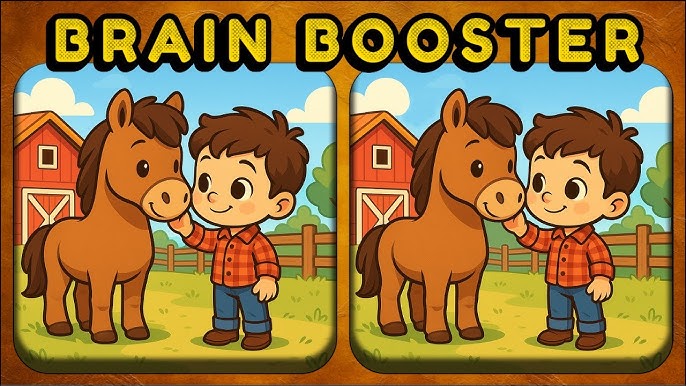
Spot-the-difference puzzles are more than just a pastime—they are a delightful way to sharpen your mind while having fun. The image above, labeled “Brain Booster,” presents a charming scene: a young boy dressed in a checkered shirt happily petting a friendly horse. Behind them, a bright red barn, a wooden fence, and a clear blue sky set the backdrop.
At first glance, both pictures look identical, but don’t be fooled. Hidden within are subtle differences that can only be spotted by the sharpest eyes. As the title suggests, this puzzle is designed to be a brain booster—a fun challenge that strengthens your attention to detail, concentration, and memory.
In this article, we’ll explore the puzzle in detail, point out the differences, discuss why spot-the-difference games are mentally stimulating, and share tips on how to solve them more effectively.
First Look at the Puzzle
The scene is heartwarming and simple:
- A little boy, smiling as he pets the horse’s nose.
- The boy wears a red checkered shirt, blue jeans, and brown shoes.
- The horse stands calmly, facing the boy.
- A barn with red walls and a triangular roof sits in the background.
- A wooden fence and some greenery complete the rural setting.
Both images look nearly identical—but upon closer inspection, you’ll find that not everything is the same.
The Hidden Differences
Now, let’s uncover the subtle differences hidden in the two images.
1. The Horse’s Tail
- In the left image, the horse has a visible tail hanging down.
- In the right image, the tail is missing completely.
This is one of the easier differences, but it’s also cleverly hidden because the horse’s legs draw much of the attention.
2. The Barn Window
- Look at the red barn in the background.
- In the left image, there is a white window clearly visible.
- In the right image, the window is absent.
Since the barn is in the background, many players overlook this detail on the first try.

3. The Boy’s Sleeve
- Focus on the boy’s right arm (on the left side of the image).
- In the left image, his sleeve shows a cuff line with detail.
- In the right image, that detail is missing.
This is a subtle difference, as our eyes tend to focus more on the boy’s face and the horse than his clothing.
4. The Fence Behind the Horse
- In the left image, the wooden fence has three horizontal planks.
- In the right image, the fence has only two visible planks.
This one blends well into the background, making it one of the trickiest differences to notice.
5. The Boy’s Shoes
- Look down at the boy’s feet.
- In the left image, both shoes are plain brown.
- In the right image, his right shoe has a small dark patch on the sole.
This is an extremely subtle change, designed to test just how observant you are.
Why This Puzzle Works as a “Brain Booster”
The title isn’t just playful—it’s true. Spot-the-difference puzzles like this one stimulate multiple areas of the brain, making them excellent tools for mental exercise. Here’s why:

- Visual Processing: You use your brain’s visual cortex to identify shapes, colors, and patterns.
- Attention to Detail: These puzzles force you to slow down and observe carefully.
- Memory Activation: You compare one image with the other, holding tiny details in short-term memory.
- Problem-Solving: Each difference you spot feels like solving a small mystery, boosting problem-solving skills.
- Stress Relief: The gentle, playful nature of these puzzles can relax the mind and reduce stress.
The Psychology Behind Spotting Differences
Why do our brains find these puzzles both challenging and addictive? The answer lies in how we process information.
- Change Blindness: Humans are prone to overlook small changes in visual scenes. This puzzle plays on that weakness.
- Selective Attention: We naturally focus on faces and central objects (like the boy and horse), ignoring background details like barns and fences.
- Reward System: Each difference spotted triggers a small dopamine release in the brain, giving us a sense of accomplishment.
This combination of challenge and reward makes spot-the-difference games endlessly engaging.
Benefits Beyond Entertainment
While they are fun, spot-the-difference puzzles offer long-term benefits too:
- For Children: Improves observation, concentration, and patience.
- For Adults: Acts as a break from daily stress while sharpening focus.
- For Seniors: Keeps cognitive functions active, reducing memory decline.
- For Teams or Families: Encourages collaboration and friendly competition.
That’s why puzzles like these are timeless and enjoyed across generations.

Tips for Solving Spot-the-Difference Puzzles
Want to become a puzzle master? Here are some effective strategies:
- Scan Systematically: Start from one corner and move across the image.
- Compare Key Areas: Pay attention to clothing, background, and small objects.
- Look for Missing Elements: Often, puzzles remove something rather than add.
- Use Short Breaks: Fresh eyes can spot differences you missed earlier.
- Zoom In (for Digital Puzzles): Enlarging the picture helps catch tiny details.
With practice, your observation speed and accuracy will significantly improve.
Why We Keep Coming Back to These Puzzles
Despite being simple in concept, spot-the-difference games remain universally popular. Here’s why:
- Accessibility: Anyone can play—no special skills required.
- Quick Fun: Can be solved in just a few minutes.
- Sharable: Perfect for social media challenges and friendly competitions.
- Nostalgia Factor: Many grew up solving these in newspapers, puzzle books, or comics.
They’re a perfect blend of challenge, relaxation, and satisfaction.

Final Thoughts
This Brain Booster puzzle is more than just a cute picture of a boy and his horse—it’s a clever mental challenge designed to test your observation skills. The differences—the missing tail, absent barn window, altered sleeve cuff, reduced fence planks, and shoe detail—are subtle yet rewarding to find.
If you spotted all the differences quickly, you’ve got an excellent eye for detail. If not, don’t worry—the very act of trying has already given your brain a good workout. Remember, every time you play puzzles like these, you strengthen your concentration, visual memory, and patience.
So, next time you come across a spot-the-difference challenge, don’t underestimate it. Dive in, take your time, and enjoy the thrill of discovery. After all, the best brain boosters are the ones that make you smile while you learn.
Leave a Reply