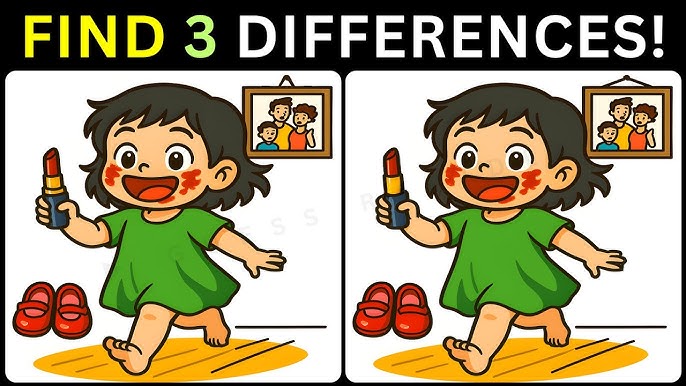
Spot-the-difference puzzles are timeless classics that never lose their charm. They combine fun, curiosity, and brainpower in a way that appeals to both children and adults. The image above is one such challenge, featuring a cheerful little girl who has clearly had some fun with lipstick! At first glance, both pictures appear identical, but if you look closer, you’ll realize there are three sneaky differences hidden in plain sight.
These puzzles are more than just games—they are mental workouts that sharpen your focus, attention to detail, and memory. In this article, we’ll carefully explore the differences in this puzzle, explain why they’re so tricky to find, and highlight the cognitive benefits of solving spot-the-difference challenges. By the end, you’ll not only know the solutions but also understand why such puzzles are a great tool for both entertainment and mental fitness.
Why Spot-the-Difference Puzzles Are So Popular
Spot-the-difference games have remained popular across generations for several reasons:
- Simple but engaging: Anyone can play—children, adults, and even seniors.
- Quick entertainment: Unlike long games, they only take a few minutes.
- Satisfying discovery: Finding a difference triggers a small reward response in the brain.
- Universal challenge: These puzzles transcend language barriers and can be enjoyed globally.
- Shareable fun: Perfect for posting on social media, sparking friendly competition.
This puzzle is no exception. It looks playful, but the differences are clever enough to stump even the sharpest eyes.

First Look: What’s in the Puzzle?
The scene is vibrant and filled with small details:
- A smiling girl in a green dress holding a lipstick in her hand.
- Her face is playfully smeared with lipstick, suggesting she’s been having fun.
- A pair of red shoes placed neatly on the floor.
- A yellow rug beneath her feet.
- A family portrait hanging on the wall in the background.
At first glance, both images look identical—but they’re not. Let’s uncover the hidden differences.
The 3 Hidden Differences Explained
1. The Girl’s Hair Ends
Take a close look at the girl’s hairstyle.
- In the left image, her hair is longer and slightly spiky at the ends on the right side.
- In the right image, her hair looks shorter and tidier.
This is a subtle but noticeable difference once you focus on her head.

2. The Family Portrait
Now shift your eyes to the family photo on the wall.
- In the left image, the family portrait shows four people.
- In the right image, the portrait shows only three people.
This difference is clever because most players are too busy looking at the girl and the objects in the foreground to notice the tiny details in the background.
3. The Shoes on the Floor
Look at the red shoes near the bottom left corner.
- In the left image, the shoes are placed neatly, side by side.
- In the right image, one shoe is missing—it only shows a single red shoe.
This is the easiest difference to spot, as the bright red color naturally draws the eye.

Why Are These Differences Hard to Spot?
The trick behind puzzles like this lies in how our brain processes visual information. Psychologists explain it using concepts such as:
- Pattern recognition: Our brain tries to recognize familiar shapes and patterns instead of focusing on tiny details.
- Focus bias: We naturally focus more on the central character (the girl) than on the background or secondary objects.
- Color distraction: Bright colors (like the green dress and red shoes) dominate the image, overshadowing smaller elements like the family portrait.
That’s why most people find one or two differences easily but struggle with the third.
The Benefits of Spot-the-Difference Puzzles
While these games are fun, they also come with valuable benefits:
- Improves Observation Skills – You learn to notice fine details that are often overlooked.
- Boosts Concentration – These puzzles require sustained attention, which enhances focus.
- Enhances Short-Term Memory – You remember what you saw in one image to compare it with the other.
- Encourages Patience and Mindfulness – Slowing down to carefully scan each part of the puzzle trains the brain to be more mindful.
- Reduces Stress – Immersing yourself in the task provides a break from daily worries, much like meditation.
- Family-Friendly Fun – These puzzles are perfect for group activities, encouraging teamwork or friendly competition.
Tips to Solve Spot-the-Difference Puzzles Faster
Want to improve your skills? Here are some proven strategies:

- Work systematically: Start from the top-left corner and move row by row.
- Check the background: Differences often hide in less obvious areas like photos, walls, or rugs.
- Focus on key categories: Look for changes in hair, clothing, objects, and shadows.
- Zoom in with your eyes: Pay attention to small shapes, patterns, and colors.
- Take breaks: If you get stuck, step away for a minute and return with fresh eyes.
Why These Puzzles Go Viral Online
Puzzles like this thrive on social media for a few reasons:
- They invite instant interaction—people love to comment their answers.
- They create friendly competition—friends challenge each other to beat their score or time.
- They provide quick entertainment—easy to try in a few minutes.
- They spark satisfaction and curiosity—even if you can’t find the answers, you want to know them.
That’s why captions like “Find 3 Differences!” instantly grab attention and encourage sharing.
Final Thoughts
This adorable lipstick-themed puzzle is a perfect example of how spot-the-difference challenges can be both playful and mentally stimulating. Out of the three differences—the girl’s hairstyle, the missing family member in the portrait, and the missing shoe—most people find the shoe first but struggle with the portrait.
So, how did you do? Did you manage to spot all three differences without checking the answers? If yes, congratulations—you have excellent observational skills! If not, don’t worry. These puzzles are designed to be tricky, and with practice, you’ll get better at spotting subtle changes.

Leave a Reply