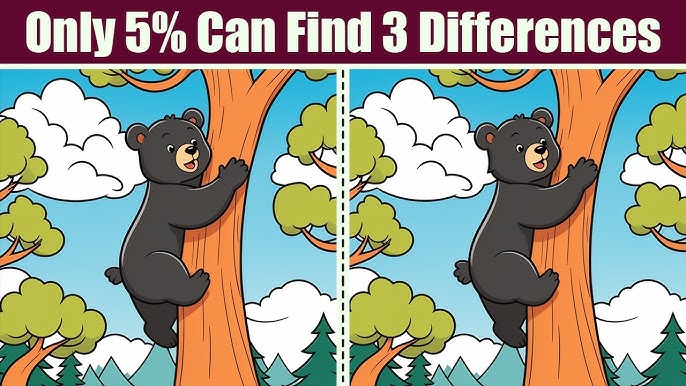
Spot-the-difference puzzles have entertained people for decades. They look simple but can be surprisingly tricky, demanding sharp eyes and focused attention. The image above is one such brain teaser, featuring a cute bear climbing a tree in the forest. But here’s the twist—there are three hidden differences between the two versions of the picture, and according to the challenge, only 5% of people can find all of them quickly.
So, are you ready to test your observation skills? Let’s dive into this charming puzzle, explore its hidden secrets, and also uncover the surprising benefits of playing these kinds of visual games.
The Puzzle at First Glance
At first sight, both pictures look exactly the same:
- A black bear happily climbing a tall tree.
- Puffy white clouds floating across a bright blue sky.
- Green treetops scattered around the scene.
- A few distant mountain peaks peeking above the forest line.
But as the caption suggests, things aren’t identical. There are three clever differences subtly tucked into the illustration. They may look like tiny artistic tweaks, but they’re designed to challenge your visual perception.
The Three Differences Explained
Let’s go step by step and uncover the three changes.
1. The Bear’s Tail
If you look at the bear on the left side, you’ll notice a small, round tail sticking out. On the right side, the tail is missing entirely! This is one of the most common tricks in spot-the-difference puzzles: removing or adding a tiny feature that you wouldn’t notice unless you pay close attention.
Why it’s tricky: Our brains tend to focus on the bear’s larger details—its face, paws, and body position—while ignoring small background features like the tail.
2. The Cloud Behind the Bear
Look carefully at the large cloud behind the bear’s head. In the left image, the cloud is shaped like a smooth puff with no interruptions. In the right image, however, part of the cloud is missing—it looks like a bite has been taken out of it!
Why it’s tricky: Our eyes often skim over clouds because they seem like background fillers. Puzzle designers know this and love hiding differences in such “unimportant” spots.
3. The Tree Branch on the Left
Check the left side of the picture where the trees are clustered. In the left image, you can clearly see a tree branch sticking out among the leaves. In the right image, that branch is missing!

Why it’s tricky: Since the brain registers tree leaves as a “pattern,” we don’t often notice small interruptions within them. Removing one branch blends in with the overall green canopy, making it harder to spot.
Why This Puzzle Is So Challenging
You may be wondering: if there are only three changes, why does it claim that only 5% of people can solve it? The answer lies in psychology and perception.
- Background Blindness
Humans naturally focus on the main subject (the bear) and often ignore the surrounding details like clouds or background branches. That makes it easy to miss at least one difference. - Overconfidence
When people see two almost identical pictures, they assume the differences will be “obvious.” This false confidence causes them to glance too quickly, skipping over subtler changes. - Pattern Recognition
Our brains are wired to group visual elements into patterns. For example, a cluster of leaves is seen as “just trees,” not individual parts. This makes it harder to notice when one small detail (like a missing branch) is altered. - Attention Span
With digital distractions everywhere, many people don’t spend more than 10–15 seconds analyzing an image. Spotting differences often requires careful, sustained attention.
The Benefits of Spot-the-Difference Puzzles
While they might seem like simple fun, these puzzles are actually powerful mental workouts. Here’s how they help:
1. Sharpening Observation Skills
Spot-the-difference puzzles train your brain to notice details that might otherwise go unnoticed. This skill is useful in real life, from proofreading documents to driving attentively.
2. Improving Concentration
Solving these challenges requires focus. The longer you practice, the better you get at tuning out distractions and honing in on small details.

3. Boosting Memory
Your short-term memory gets engaged as you compare features between the two images. This strengthens your working memory, which plays a role in learning and problem-solving.
4. Stress Relief
Believe it or not, these puzzles can be relaxing. Like meditation, they keep your mind engaged in the present moment, giving you a break from stress or overthinking.
5. Enhancing Patience
Spot-the-difference requires persistence. Learning to patiently search for details can build resilience and determination in other areas of life.
Strategies to Spot Differences Faster
If you struggled with this puzzle, don’t worry. Here are a few practical tips that can help you improve:
- Start with the Outline
Compare the outer edges of the images first. Often, puzzle creators hide changes in corners, outlines, or borders. - Scan Systematically
Instead of darting your eyes randomly, scan from top to bottom or left to right. This ensures you cover the entire image. - Look at Backgrounds
Most people focus only on the main character, but many differences are hidden in the background (like the missing branch or cloud here). - Use the Blink Method
Quickly switch your gaze back and forth between the two images. Differences will seem to “jump out” as your eyes detect inconsistencies. - Zoom In (if digital)
On digital puzzles, zooming in can reveal tiny details you might miss at normal size.
Why This Puzzle Stands Out
Among many spot-the-difference puzzles, this one is special for a few reasons:

- It’s Cute and Wholesome: The bear climbing the tree makes the puzzle lighthearted and fun for all ages.
- Balanced Difficulty: The differences are not too easy but not impossibly hard either, making it perfect for casual players.
- Visual Appeal: Bright colors, a cheerful forest setting, and a charming animal make the puzzle inviting to engage with.
Spot-the-Difference in Everyday Life
What’s fascinating is that the skills you practice here apply beyond puzzles:
- In Schools: Teachers use these games to sharpen young children’s attention to detail and observational skills.
- In Workplaces: Professions like pilots, surgeons, and quality-control inspectors benefit from exercises that train precise observation.
- In Therapy: Occupational therapists use them to help patients recover memory, attention, and cognitive abilities.
So, while it looks like “just a game,” spot-the-difference can actually boost skills that matter in daily life.
Did You Spot All Three?
Now that we’ve revealed the three differences—the missing tail, the altered cloud, and the missing branch—how many did you get on your own? If you found all of them quickly, congratulations—you’re among the sharp-eyed 5%! If you struggled, don’t be discouraged. Remember, the real reward isn’t just in solving the puzzle but in the process of searching, focusing, and engaging your brain.
Final Thoughts
This bear-themed puzzle is a perfect example of why spot-the-difference challenges remain timelessly popular. They combine fun, mental exercise, and a touch of friendly competition. Whether you play them to relax, to sharpen your focus, or simply for nostalgia, one thing is certain: they’re more than just child’s play.
So, the next time you come across a spot-the-difference challenge, don’t scroll past it. Take a few minutes, engage your eyes and brain, and see if you can beat the odds. Who knows—you might just discover that you belong to the sharp-eyed 5% who always spot the differences.

Leave a Reply