In today’s fast-paced digital world, it’s more important than ever to keep our minds sharp and active. One of the best ways to do that is through visual puzzles—simple, fun, and incredibly effective in improving cognitive skills. In this article, we explore a delightful “Find the Difference” puzzle that not only entertains but also boosts observation, attention to detail, and problem-solving skills.
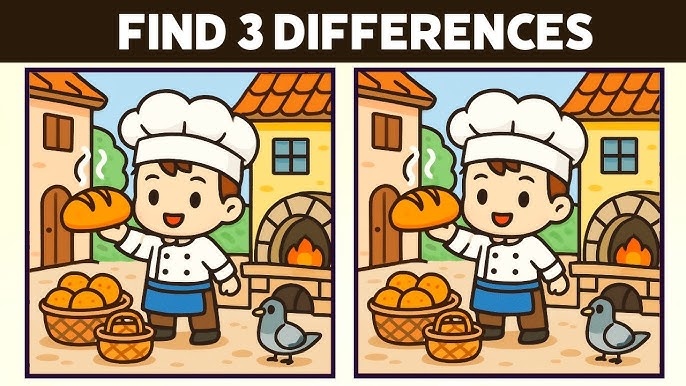
Let’s take a closer look at the charming bakery-themed puzzle that asks you to “Find 3 Differences” between two seemingly identical images. At first glance, they appear the same, but upon careful inspection, subtle differences begin to emerge. Ready to put your brain to the test? Let’s dive in.
🧠 Why Spot the Difference Puzzles Matter
Before we dive into the differences, let’s understand the purpose behind such puzzles.
Cognitive Benefits:
- Improves Focus: Spotting differences requires intense concentration, helping train the brain to focus on small details.
- Enhances Visual Memory: Regularly practicing these puzzles helps improve short-term visual memory.
- Boosts Pattern Recognition: These activities sharpen your ability to detect patterns and inconsistencies.
- Reduces Stress: Believe it or not, these puzzles offer a calm and meditative effect that can reduce anxiety.
Whether you’re a child learning to recognize patterns or an adult looking to keep your mind agile, these puzzles are beneficial across all age groups.
🎨 The Scene: A Peaceful Bakery in a Quaint Village
The image presents a picturesque village bakery scene. In both panels, we see:
- A happy baker proudly holding a loaf of bread.
- A basket of round bread rolls in front of him.
- A smaller basket (presumably for collecting or serving).
- A curious pigeon standing near the baker.
- A charming background featuring tiled rooftops, windows, a bakery oven, and a cobblestone ground.
The artwork is bright, cheerful, and cartoonish—perfectly suited for children yet engaging enough for adults.
But hidden within this adorable scene are three subtle differences that test your powers of observation.
🔎 Can You Find All 3 Differences?
Before reading further, take a good look at both images. Can you find all three differences without any hints? Set a timer for 60 seconds and give it a try!
…
Time’s up! Let’s reveal the differences.
✅ Difference 1: The Window Pane
Look closely at the house in the background on the right side of both images. In the left image, the blue window has four square panes (a standard grid). However, in the right image, the same window is missing one pane, resulting in only three visible sections.
This difference is a test of attention to background details. It’s easy to focus only on the central characters and overlook the buildings, but a careful eye will spot the irregularity in the window.
🧠 What it tests: Visual memory and attention to background details.
✅ Difference 2: The Pigeon’s Wing Color
Now direct your attention to the bottom right of both images, where the pigeon is standing. In the left image, the pigeon’s wing is light gray, matching the rest of its body. But in the right image, the pigeon’s wing has a darker gray hue.
This difference plays with our perception of colors and shades. It’s subtle enough to be overlooked unless you’re really focusing on the bird.
🧠 What it tests: Color discrimination and detail recognition.
✅ Difference 3: The Baker’s Buttons
Let’s bring the focus back to our smiling baker. His white chef coat is decorated with black buttons. In the left image, he has three buttons. However, in the right image, the middle button is missing, leaving only two.
This is one of the more hidden differences since the buttons are small and might blend into the coat visually. But once you spot it, it’s clear as day!

🧠 What it tests: Spatial awareness and pattern spotting in clothing.
🧩 How to Use This Puzzle in Learning and Development
📚 In Education:
Teachers and parents can use such puzzles in classrooms or at home to:
- Develop early childhood cognitive skills.
- Improve language development by encouraging children to describe what they see.
- Teach vocabulary (e.g., loaf, basket, pigeon, windowpane).
- Foster patience and focus in young learners.
👨👩👧 For Families:
This puzzle is a fantastic family activity. Whether you print it out or solve it on a tablet, everyone can participate. Turn it into a mini-competition to see who spots all the differences first!
🧓 For Seniors:
Such puzzles are highly recommended for older adults as part of cognitive maintenance. They help keep the mind active and are often used in memory care programs.
🎯 Tips for Solving Spot the Difference Puzzles
If you found this puzzle tricky, don’t worry! Here are some helpful strategies:
- Divide the Image into Sections: Mentally split the image into quadrants and compare them section by section.
- Start with the Background: Most people begin with the foreground. Try flipping the focus to the background for hidden changes.
- Check for Color Variations: Look out for slight shifts in shade or brightness.
- Compare Objects One at a Time: Focus on one object (like the bread, pigeon, or baskets) and compare them directly.
- Zoom In: If you’re viewing the image digitally, zooming in can help catch finer details.
📈 The Growing Popularity of Visual Brain Teasers
In recent years, puzzles like these have seen a resurgence, thanks to social media. Platforms like Instagram, Facebook, and Pinterest are full of visual brain teasers and “Find the Difference” challenges. They’re bite-sized, shareable, and instantly satisfying.

Many puzzle books, apps, and educational websites have also incorporated them into their content, recognizing the value they bring in both entertainment and education.
🧩 More Than Just a Game
What makes this bakery-themed puzzle stand out is its universal appeal. The artwork is adorable and inviting. The differences are challenging yet fair. It’s the kind of puzzle that makes you smile even as you furrow your brow in concentration.
Such puzzles serve as a reminder that learning and brain training don’t have to be dull or tedious—they can be joyful and artistic.
🖼️ Create Your Own Spot the Difference Puzzle!
Inspired? Why not try making your own?
All you need is:
- Two copies of a digital drawing or photo.
- Simple edits using a graphic design tool (like Canva, Photoshop, or even MS Paint).
- Change small details—remove or add objects, change colors, or tweak shapes.
This is a fantastic art-and-observation exercise for students, artists, or hobbyists who love visual storytelling.

💬 Final Thoughts
This “Find 3 Differences” puzzle is more than just a fun activity—it’s a brain-boosting, creativity-sparking challenge wrapped in a whimsical illustration. From kids learning observation skills to adults seeking a moment of relaxation, this puzzle delivers joy and mental stimulation in equal measure.
Next time you come across a similar image, take a moment to slow down and really look. You’ll be amazed at what your eyes—and your brain—can discover.
So, did you find all three differences? Share this puzzle with a friend and see if they can spot them too!
Leave a Reply