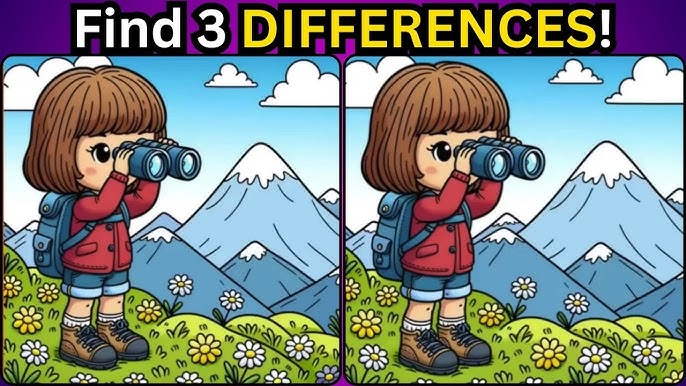
In a world flooded with digital noise and endless scrolling, there’s something refreshingly simple — and surprisingly satisfying — about a good ol’ “Find the Differences” puzzle. It’s one of those timeless visual games that transcends age, language, and even culture. Whether you’re a young learner, a casual puzzler, or an adult looking to give your brain a workout, spotting subtle differences between two nearly identical images is both fun and mentally stimulating.
Today, we explore an enchanting “Find 3 Differences” puzzle featuring a young girl hiking in the mountains — a visually rich and detailed illustration that hides its secrets well. Let’s dig into the scene, identify the differences, and discuss the cognitive benefits and educational value of these charming visual games.
🌄 Puzzle Overview: A Scenic Hike in the Mountains
The image presents two versions of a picturesque nature scene. A young girl with a bob haircut, dressed in a red jacket and hiking boots, is standing in a lush green field filled with daisies and wildflowers. She’s using binoculars to admire the majestic snow-capped mountains ahead, under a bright blue sky dotted with fluffy white clouds.
At first glance, the two images look identical. But if you pause and observe carefully, you’ll realize there are three sneaky differences between them. And it’s your job to find them!
🔎 The 3 Hidden Differences — Solved!
Here’s a closer look at the three differences between the two images:
1. The Missing Hair Strand
- Left Image: The girl’s bangs feature a small loose hair strand near the middle of her forehead.
- Right Image: That strand is completely missing; the bangs appear smooth and undisturbed.
Why it’s tricky: Hair patterns are subtle, and the change is incredibly minor. Our eyes usually focus on faces or clothing before hair details, so this one is easily missed unless you’re really focused.
2. Extra Flower on the Ground
- Left Image: The grassy foreground features several flowers, but not overly crowded.
- Right Image: A new flower appears on the left-hand side near the girl’s legs, adding to the flora.
Why it’s clever: Our brains see the greenery and flowers as background decoration and often gloss over them unless we deliberately compare petal-for-petal. This extra flower blends in naturally, making it a camouflaged difference.
3. Cloud Position Shift
- Left Image: The leftmost cloud near the mountain is positioned slightly higher and is fuller.
- Right Image: That same cloud appears lower and more stretched — the shape and position are altered.
Why it works: Clouds are part of the background, and many assume they stay the same unless there’s a dramatic change. This subtle shift in size and position is just enough to cause a second look — a classic strategy in spot-the-difference puzzles.
🧠 The Mental Benefits of Spot the Difference Games
Puzzles like this one may look like child’s play, but they’re a mental workout disguised as fun. Let’s explore the hidden educational and cognitive benefits that come with identifying visual differences:
✅ 1. Boosts Attention to Detail
This puzzle forces the viewer to slow down and really look. In our fast-paced world, slowing down and being present can be a game-changer — especially for kids learning to pay closer attention to their environment.

✅ 2. Enhances Visual Memory
As you scan one image and try to remember its layout, you’re strengthening short-term visual memory. This translates into real-world skills, from reading comprehension to pattern recognition.
✅ 3. Develops Patience and Focus
You can’t rush through these puzzles — especially well-drawn ones like this. Practicing this patience is a valuable skill for both kids and adults.
✅ 4. Supports Left-Right Brain Coordination
You’re not just using logic and analysis (left brain) but also visual creativity and spatial awareness (right brain). That holistic cognitive exercise is rare and precious in one single activity.
✅ 5. Reduces Stress and Promotes Mindfulness
There’s something soothing about focusing on a simple, enjoyable task like this. It promotes mindfulness, which is proven to reduce anxiety and increase clarity.
🧑🏫 Educational Applications in Schools and Homes
This puzzle is more than just a time-killer — it’s a powerful tool in early childhood education, special needs learning, and even ESL classrooms. Here’s how educators and parents can use puzzles like this:

📘 In the Classroom
- Use it as a visual warm-up before a reading or observation-based activity.
- Incorporate it into science lessons when discussing ecosystems, flowers, or mountain geography.
- Great for language development: Have students describe what they see using full sentences.
🧩 For Special Needs Learning
- Helps children on the autism spectrum or with ADHD practice attention to detail in a non-overwhelming way.
- Can be printed and laminated for tactile use, allowing physical pointing or matching.
👨👩👧 At Home with Families
- Make it part of family game night. Set a timer and see who can find all three differences the fastest.
- Use it as a peaceful wind-down activity before bed — screen-free and stress-relieving.
🎨 Why This Puzzle Stands Out
Let’s take a moment to appreciate the art style and thoughtful design of this puzzle:
- Color Harmony: Bright but not overwhelming. Blues, greens, and whites dominate, which are soothing to the eyes.
- Character Design: The girl is adorably drawn with simple yet expressive features. Her stance shows curiosity — a wonderful model for young viewers.
- Background Detail: The flowers, hills, and mountains are rich with visual cues but not so busy that they distract.
The blend of character, setting, and soft color palette makes this puzzle both beautiful and effective as a learning tool.
🔁 Make Your Own “Spot the Difference” Puzzle
Feeling inspired? Try this fun art challenge:
- Step 1: Draw a simple outdoor scene — maybe a picnic, a playground, or a beach.
- Step 2: Copy it and tweak 3–5 small elements.
- Step 3: Challenge friends or siblings to spot the changes!
This is an excellent creative activity for children to express themselves while developing observation skills.
🧠 Final Reflection: What Makes Spot-the-Difference Timeless?
What is it about these puzzles that has kept them in newspapers, books, classrooms, and now digital platforms for generations?

- They’re universally accessible — no language or reading skills required.
- They appeal to our innate curiosity — we want to solve things.
- They deliver instant gratification — every found difference brings a little dopamine hit.
- They’re portable and simple — you can do one in 30 seconds or spend 10 minutes savoring it.
And most importantly, they engage the mind without exhausting it — making them a perfect blend of relaxation and stimulation.
🏁 Conclusion: Did You Find All 3?
To summarize, the differences in this delightful puzzle are:
- Strand of hair missing in the right image.
- Extra flower near the girl’s legs in the right image.
- Shifted cloud shape and position in the sky.
Whether it took you 30 seconds or several minutes, you just exercised your brain and had fun doing it. Keep exploring, keep observing, and never stop challenging your mind!
Liked this puzzle challenge? Share it with a friend or bring it to your classroom or family game night. There’s always more to see — if you’re willing to look a little closer.
Happy puzzling! 🌤️🌼🧠

Leave a Reply