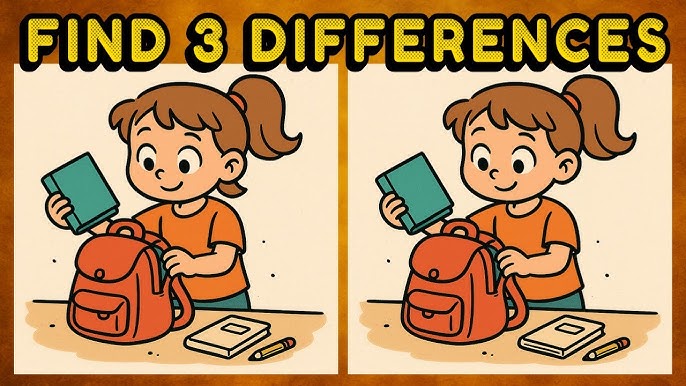
In today’s fast-paced digital world, we often look for small yet effective ways to relax, engage our minds, and have fun at the same time. One of the simplest yet most delightful activities to achieve this balance is solving a classic “Find the Difference” puzzle. The image shown above is a perfect example of this entertaining challenge. At first glance, both pictures seem identical: a cheerful young girl is packing her backpack, ready to place her book inside while her stationery rests neatly on the desk. But if you look closely, you’ll notice that three clever differences have been hidden between the two versions.
Spot-the-difference puzzles like this one have been around for generations, often featured in children’s books, newspapers, and magazines. Today, they’re widely shared online as a fun activity for people of all ages. But beyond the amusement, these puzzles offer a surprising range of benefits, from sharpening your focus to boosting problem-solving skills. Let’s dive into the details of this puzzle, explore the differences hidden in the picture, and uncover the many reasons why this small brain exercise deserves your attention.
The Puzzle: A Girl Packing Her Bag
The scene portrayed in the puzzle is charming and familiar. A young girl, likely preparing for school, is holding a book in one hand while the other rests on her bright orange backpack. On the table in front of her, a notebook and a pencil are laid out. Everything looks perfectly ordinary, which is exactly what makes spot-the-difference puzzles so engaging—because the challenge lies in observing the tiniest of details.
At first glance, both images appear identical. But if you look with a sharper eye, you’ll start to uncover the subtle distinctions that make the puzzle exciting.

The Three Hidden Differences
Let’s reveal the three key differences between the two pictures:
- The Girl’s Ponytail
- In the left image, the girl’s ponytail is drawn neatly, with one visible hair loop.
- In the right image, the ponytail is slightly different—it has a longer and more curved shape. This subtle variation is one of the hidden differences you need to spot.
- The Backpack Pocket
- On the left side, the backpack’s front pocket is drawn larger and rounder, giving it a more spacious look.
- On the right side, the pocket is smaller and slightly shifted in position, which may be easy to miss at first glance.
- The Notebook on the Desk
- In the left image, the notebook lies flat with no extra markings.
- In the right image, the notebook has a line or rectangular marking on the cover, creating a small but noticeable distinction once you spot it.
These three changes may seem minor, but that’s exactly the magic of such puzzles—they challenge our ability to notice fine details that our brains might otherwise overlook.
Why Spot-the-Difference Puzzles Are So Popular
Spot-the-difference games are timeless because they are simple, accessible, and enjoyable. You don’t need any special tools or skills—just a pair of eyes and a curious mind. Children love them for the playful challenge, while adults appreciate them as a quick, stress-relieving break from daily routines.
Their popularity can also be attributed to the sense of satisfaction they bring. Finding a hidden difference is rewarding, almost like solving a mini-mystery. It taps into the natural human desire for discovery and achievement.

Benefits of Solving Spot-the-Difference Puzzles
While they may seem like just a fun distraction, these puzzles actually provide a variety of mental and emotional benefits:
1. Improves Attention to Detail
These puzzles train your brain to look carefully at images, encouraging you to notice small details that you might normally overlook. This skill can translate into everyday life, helping you become more observant at work, in studies, or even in simple tasks like remembering where you left your keys.
2. Boosts Concentration
In a world full of distractions, spot-the-difference puzzles force you to focus fully on one task. This practice of deep concentration can help improve your attention span over time.
3. Enhances Memory Skills
As you compare images, your brain constantly recalls what you’ve seen in one picture while checking against the other. This exercise strengthens short-term memory, which is particularly beneficial for children developing cognitive skills and for adults wanting to keep their minds sharp.

4. Encourages Problem-Solving and Patience
Puzzles like these require persistence and logical thinking. Sometimes the differences aren’t immediately visible, and solving them teaches you patience and determination—skills that are invaluable in both personal and professional life.
5. Stress Relief and Relaxation
Just like coloring books or simple games, spot-the-difference puzzles can provide a calming effect. They allow you to take a mental break, shifting your focus away from worries and reducing stress.
Educational Value for Children
For children, these puzzles aren’t just fun—they are educational. Teachers and parents often use them as learning tools because they:
- Develop visual perception and recognition skills.
- Strengthen hand-eye coordination when children point out or circle differences.
- Encourage critical thinking by making kids compare and contrast images.
- Provide a fun way to practice patience and focus in a low-pressure environment.
When presented in a colorful and engaging format, like the one with the girl and her backpack, they become even more appealing to young learners.

A Timeless Activity in the Digital Age
With smartphones and digital platforms, spot-the-difference puzzles have found new life online. Apps, interactive games, and websites now offer endless variations, sometimes with increasing levels of difficulty or time-based challenges. These modern adaptations keep the game fresh while still retaining its classic charm.
The puzzle in the image above is a perfect example—it blends simplicity with creativity, making it equally enjoyable for both kids and adults.
Tips for Solving Spot-the-Difference Puzzles
If you find yourself struggling to identify differences, here are a few helpful strategies:
- Scan Systematically – Instead of randomly looking at the picture, start from the top left and move your eyes across in a structured way.
- Compare One Area at a Time – Focus on specific objects (like the backpack, hair, or desk) before moving to the next.
- Take a Break – If your eyes get tired, step away for a minute. Fresh eyes often spot differences quickly.
- Look for Patterns – Differences often involve changes in shape, color, size, or missing/added details.
Using these methods, you’ll improve your accuracy and speed in spotting even the trickiest differences.

Conclusion
The “Find the 3 Differences” puzzle featuring the girl with her backpack is more than just a fun brain teaser—it’s a delightful exercise in observation, focus, and patience. Whether you spotted the ponytail change, the backpack pocket variation, or the notebook marking right away, the satisfaction of solving the puzzle is undeniable.
Beyond the entertainment value, puzzles like these help sharpen our minds, reduce stress, and even support children’s learning and development. In a world where we’re constantly juggling responsibilities and distractions, taking a few minutes to enjoy a simple yet stimulating activity like this can be surprisingly beneficial.
So the next time you come across a spot-the-difference puzzle, don’t just pass it by—take a closer look, challenge yourself, and enjoy the little victory of finding what others might miss. After all, sometimes it’s the smallest details that bring the biggest smiles.
Leave a Reply