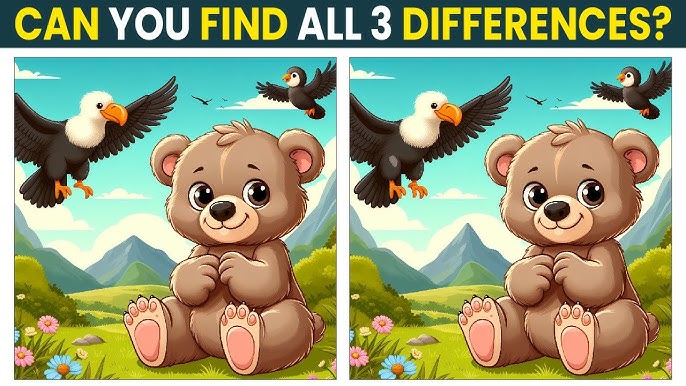
Sometimes, the most effective brain workouts come wrapped in the simplest, cutest packages—and that’s exactly what we have here today. In this delightful visual puzzle, you’re invited to spot three subtle differences between two seemingly identical images featuring a cuddly bear cub and a beautiful mountain backdrop.
At first glance, the two pictures look exactly the same. But look closer—and sharpen those observation skills! This charming challenge isn’t just a fun game; it’s also a clever mental exercise designed to train your focus, visual perception, and attention to detail.
Let’s take a closer look at this scene, discover the differences, and explore how puzzles like these benefit brains of all ages.
🌄 Scene Description: A Peaceful Day in the Mountains
The setting is picturesque and serene—lush green grass, rolling hills, towering mountains, and a clear blue sky scattered with fluffy white clouds. Right in the foreground sits a big-eyed baby bear, with rosy paws, folded arms, and a sweet expression.
Hovering above the bear are two birds, resembling bald eagles or vultures, soaring against the beautiful backdrop. Wildflowers and rocks dot the meadow, adding more depth and charm to the scene.
The left and right images look almost identical. But if you pause and engage your powers of observation, you’ll uncover the three sneaky changes that set them apart.
🔍 Can You Find All 3 Differences?
Here’s where the real fun begins. Let’s break down each of the three differences between the two images:
✅ 1. Bird’s Beak Color (Top Left Bird)
In the left image, the bird on the left has a bright orange beak, a detail that stands out against its dark feathers. However, in the right image, the beak is noticeably darker—almost black—blending more into the bird’s body.
👉 What it tests: This subtle color shift challenges your brain to detect changes in hue and contrast—key skills used in fields like graphic design, art, and visual inspection.
✅ 2. Missing Flower (Bottom Left)
Look carefully at the grassy area to the left of the bear’s feet. In the left image, there’s a prominent purple flower blooming from the grass. In the right image, this flower is missing, leaving just the green grass behind.
👉 What it tests: Spotting an element that’s missing from a crowded scene takes concentration and sharp visual scanning. This also boosts pattern recognition and spatial memory.
✅ 3. Bear’s Ear Inner Color (Right Ear)
This difference is trickier: focus on the inside of the bear’s right ear (on your left as you look at the image). In the left image, the inner ear is pink, matching the left ear. But in the right image, the inner color of that ear is brown, blending with the rest of the bear’s fur.
👉 What it tests: This detail requires close inspection and engages your ability to detect asymmetry—a critical skill for editing, drawing, and even medical diagnosis.
🧠 The Hidden Power of “Spot the Difference” Puzzles
So why are puzzles like these more than just casual fun? Let’s explore the wide range of cognitive, psychological, and educational benefits they offer.
🧩 1. Boosts Visual Discrimination
“Spot the Difference” puzzles train your eyes and brain to detect tiny variations in shape, color, and placement. This improves visual discrimination—the ability to notice what’s different, which is vital in everything from reading to sports performance.
🔁 2. Enhances Working Memory
To solve these puzzles, you need to remember elements from one image while scanning the other. This strengthens your working memory, a key factor in academic success, problem-solving, and multitasking.
👁️ 3. Improves Attention Span
Today’s digital world is filled with distractions. Focusing on visual puzzles helps you practice sustained attention, which is essential for completing tasks, learning new skills, and even mindfulness.
💡 4. Encourages Logical Thinking
Even though the puzzle is visual, the process is highly analytical. You eliminate matched areas and zero in on inconsistencies. Over time, you develop strategic thinking and pattern-solving techniques.

🧘 5. Promotes Relaxation and Mindfulness
These puzzles aren’t just stimulating—they’re also calming. Solving them brings you into the present moment and can help reduce anxiety, much like meditation or adult coloring books.
🎓 Educational Uses of Spot the Difference Games
Whether you’re a parent, teacher, or therapist, “Spot the Difference” puzzles are fantastic tools for education and cognitive development.
📚 For Young Children:
- Develops vocabulary (ears, beak, flowers, clouds, etc.).
- Strengthens left-right orientation and visual-motor skills.
- Builds patience and encourages observational discipline.
📖 For ESL/EFL Learners:
- Use the puzzles to practice descriptive language: “The bird has a black beak in this picture, but an orange beak in that one.”
- Improves vocabulary and understanding of prepositions and adjectives.
🧓 For Seniors:
- Encourages neuroplasticity by engaging problem-solving and memory.
- Used in memory care and occupational therapy to slow cognitive decline.
- Provides a fun and low-stress mental workout.
🌈 Why This Puzzle Works So Well
The effectiveness of this bear-themed visual puzzle lies in its balance of simplicity and detail:
✔️ Bright, Distinct Colors:
The cartoon-style colors make each object easy to identify, yet slight hue changes (like the beak or inner ear) create just enough of a challenge.
✔️ Clear Layout:
There’s not too much clutter, so players won’t get overwhelmed. Instead, they’re invited to examine key areas more deeply.
✔️ Emotional Engagement:
The cute bear, peaceful setting, and friendly birds create positive emotions, which are proven to enhance learning and memory retention.

🎯 Tips to Solve Spot the Difference Puzzles More Efficiently
Want to become a puzzle pro? Here are some expert-level strategies:
✅ 1. Use a Systematic Grid Approach
Divide the image into four or six sections and inspect one area at a time. This reduces missed details.
✅ 2. Compare from Left to Right or Top to Bottom
Don’t jump around—scan consistently in one direction.
✅ 3. Look for Categories of Change
Common changes include:
- Color (like the beak)
- Additions or removals (like flowers)
- Shape or size
- Symmetry breaks (like the ear)
✅ 4. Blink Quickly Between Images
If digital, toggle between them. Human eyes are great at spotting movement or small discrepancies this way.
🎨 Want to Create Your Own Puzzles?
Creating your own Spot the Difference puzzle is a great activity for:

- Teachers (educational handouts)
- Parents (fun family games)
- Designers (interactive content)
- Bloggers (audience engagement)
Tips:
- Start with simple illustrations.
- Make 3–5 changes per puzzle.
- Keep differences subtle but fair.
- Offer hints for young or beginner players.
🧸 Final Thoughts: A Bear-y Good Brain Workout
This adorable bear may be sitting peacefully in a meadow, but the mental challenge he brings is anything but sleepy! The differences hidden between the two scenes serve as gentle yet powerful exercises in perception, logic, and memory.
Whether you’re solving puzzles solo, competing with friends, or using them as a learning tool in class, “Spot the Difference” games bring joy, focus, and a sense of accomplishment to all ages.
So, did you find all 3 differences? If not, no worries! Keep practicing—your brain, just like a muscle, gets stronger with every challenge.
💬 We’d Love to Know:
- Which difference took you the longest to find?
- Do you want more puzzles like this?
- Should we turn these into a printable activity sheet or app?
Let me know if you’d like this formatted into a printable PDF, an interactive webpage, or even made into a series of puzzles. I can also write versions tailored for children’s books, blogs, or classroom worksheets!
Leave a Reply