Visual puzzles have always intrigued the human mind. From crosswords to optical illusions, they challenge our attention, patience, and focus. Among them, “Spot the Difference” puzzles hold a timeless charm — simple to understand yet deeply engaging.
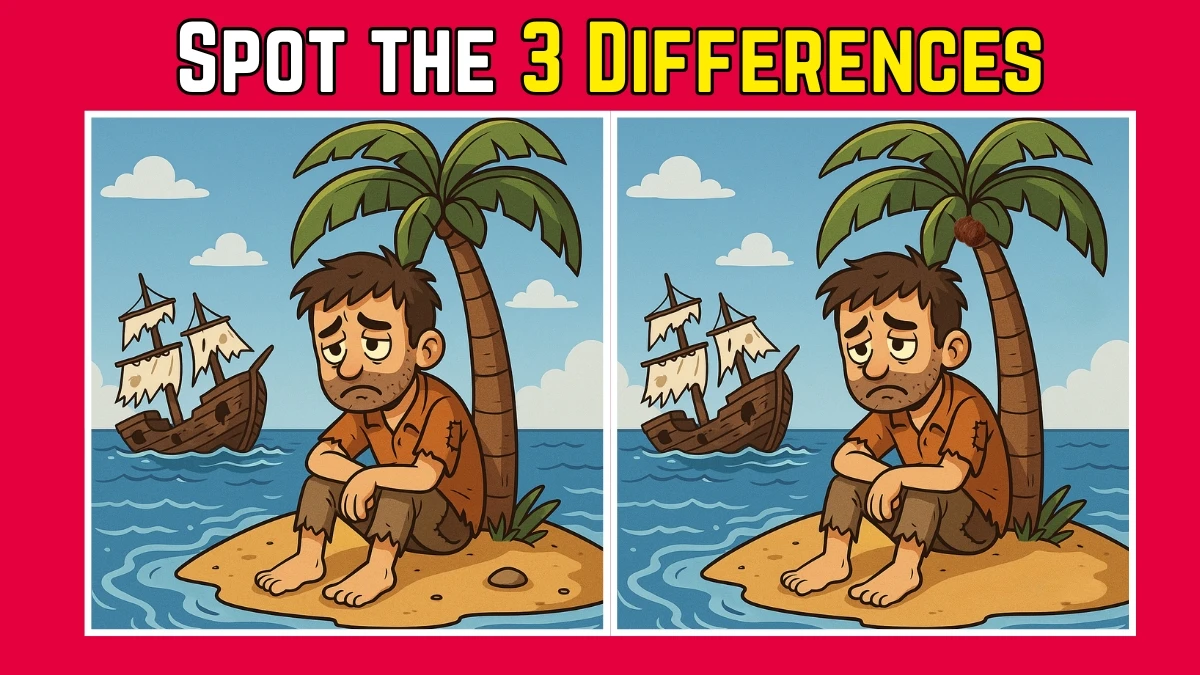
In the image above, we see a lonely man stranded on a tiny island under a palm tree, with a wrecked ship in the background. At first glance, everything seems identical in both pictures. But look closer — three subtle differences are hidden in plain sight, waiting to be discovered.
Are your eyes sharp enough to find them all? Let’s take a closer look at this fascinating scene and what makes puzzles like these so rewarding.
🏝️ The Scene: A Castaway’s Tale
The image captures a moment that feels straight out of a storybook — a castaway stranded on a deserted island. The man, dressed in a torn orange shirt and brown pants, sits on the sand with a sad expression. His messy hair and tired face reveal that he’s been alone for a long time. Behind him stands a single palm tree — the only sign of life on the tiny island.
In the background, a wooden ship floats on the calm sea, its sails tattered by time and weather. A few fluffy clouds drift lazily across the sky, adding to the peaceful yet lonely atmosphere of the scene. The setting sun casts a warm glow, painting a picture that’s both melancholic and beautiful.
But while the two images seem identical, they hide three cleverly placed differences that only the most observant minds can find.
🔍 The Challenge: Find the 3 Differences
Before we reveal the differences, take a moment to really look at both pictures. Observe the palm leaves, the man’s clothes, the ship, and even the sand beneath his feet.
These puzzles are designed to test your attention to detail, visual memory, and focus under pressure. Even though the task seems simple, our brains are naturally wired to look at the “big picture,” which makes spotting subtle variations more difficult than it sounds.
Take a few seconds. Can you find all three?
✅ The 3 Hidden Differences Revealed
If you’ve been searching carefully, you might have spotted a few of these already. Let’s go over them one by one:
- The Missing Coconut on the Palm Tree
In the left image, the palm tree has a large brown coconut hanging just beneath its leaves. But in the right image, the coconut is missing! It’s a tiny change that can easily go unnoticed unless you look closely at the tree. - The Ship’s Flag
Look carefully at the ship in the background. In the left image, one of the ship’s flags is missing. It’s a small but striking difference that tests your ability to notice distant background details — something our brains often ignore first. - The Man’s Shirt Tear
The man’s orange shirt has a visible tear on his sleeve in one image, while in the other, it’s completely intact. This difference draws attention to the foreground and challenges your ability to detect variations in textures and patterns.
Each of these differences focuses on a different type of visual perception: color, shape, and object recognition. Together, they form a perfect trio of challenges for any keen observer.
🧠 Why “Spot the Difference” Puzzles Train Your Brain
While they may seem like just a fun distraction, puzzles like this one are scientifically proven to enhance several mental skills. Here’s what happens in your brain when you play:
- Improved Attention Span: Your brain learns to focus on small details and ignore distractions, improving concentration.
- Enhanced Memory: You subconsciously remember the first image while comparing it to the second, exercising visual and short-term memory.
- Better Pattern Recognition: Over time, you develop a keener sense of identifying inconsistencies in patterns — a useful skill in problem-solving and everyday life.
- Stress Relief: Engaging in visual puzzles triggers a “flow” state, similar to meditation, reducing anxiety and promoting calmness.
In short, every time you play a game like this, you’re giving your brain a workout — but one that feels relaxing rather than stressful.
🧩 The Psychology Behind the Challenge
Humans are visual creatures. Our brains are wired to notice movement, color, and faces instantly, but we often miss small variations in static scenes. Psychologists refer to this as “change blindness.”
Change blindness occurs when we fail to notice subtle changes in a visual scene because our brain assumes that everything is the same unless there’s a major motion cue. That’s exactly what makes “spot the difference” puzzles so intriguing — they exploit this natural cognitive limitation.

By practicing these puzzles, we train ourselves to overcome change blindness and heighten our awareness of the little things we often ignore.
🌅 A Story Hidden in the Image
Beyond the puzzle lies a story — one that invites imagination.
The man in the picture could be a sailor whose ship was wrecked by a storm. Now stranded on a small island with nothing but a palm tree for shade, he stares at the horizon, hoping for rescue. The passing ship in the distance could be his last hope — or perhaps it’s just a mirage, a dream born of desperation.
Each detail tells part of his story: his torn clothes, his weary eyes, and the quiet sea around him. Even the missing coconut in one of the images can symbolize loss or change — a reminder that everything in life, no matter how small, plays a part in the bigger picture.
This emotional backdrop gives the puzzle more depth. You’re not just looking for differences — you’re exploring a tiny narrative of hope, solitude, and resilience.

⏱️ The 7-Second Challenge
Many online puzzle enthusiasts take the 7-second challenge — to find all three differences within seven seconds. It might sound easy, but it’s surprisingly difficult.
If you managed to spot all three within that time, congratulations! You have exceptional visual recognition skills. For most people, it takes between 15 and 25 seconds, depending on focus and experience.
The next time you try a similar challenge, set a timer. The pressure adds excitement and tests how quickly your brain processes visual cues under time constraints.
🖼️ How to Create Your Own Spot-the-Difference Puzzle
If you enjoyed this puzzle, you can easily create your own version to share with friends or on social media. Here’s how:
- Choose an image — preferably one with many small details (like a landscape, café, or street view).
- Make small edits — change colors, remove objects, or alter patterns using photo-editing tools.
- Keep a balance — one easy, one medium, and one hard difference create the best puzzle experience.
- Challenge your friends — see who can find them the fastest and share the results online.
Creating puzzles like this is not only fun but also a great way to engage people visually.

🌊 The Hidden Lessons Behind the Game
Beyond entertainment, “Spot the Difference” puzzles carry deeper life lessons. They teach us to slow down and pay attention. In today’s fast-paced digital world, where we scroll through hundreds of images and videos daily, we rarely take the time to observe.
This simple exercise reminds us that details matter — in art, in work, and in relationships. The small things we often overlook can completely change our understanding of the bigger picture.
Just like in the puzzle, where missing a coconut or a tear in a shirt alters the scene, in real life, noticing small details can make a big difference — whether it’s catching a mistake at work or recognizing someone’s unspoken emotions.
🎯 Conclusion: The Power of Observation
The “Spot the 3 Differences” castaway puzzle isn’t just a fun brain teaser — it’s a celebration of human observation and mindfulness. The deserted island setting adds a poetic touch, reminding us of solitude, focus, and awareness.
Leave a Reply