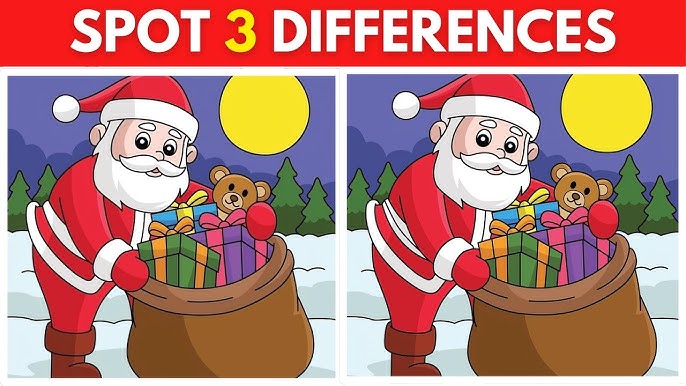
As snow blankets the rooftops and festive lights twinkle in the chilly air, the holiday season brings joy, warmth, and the thrill of timeless traditions. Among the classics—caroling, gift-giving, gingerbread houses—there’s one low-tech, brain-boosting game that generations have enjoyed: the “Spot the Difference” puzzle.
The charming image above, featuring Santa Claus with his bag of gifts, is more than just a festive illustration. It hides a clever visual challenge: three subtle differences between the two pictures. But this activity is not just a test of your eyes—it’s a holiday workout for your brain.
In this article, we’ll take you on a fun sleigh ride through:
- The differences hidden in the Santa image
- Why spot-the-difference puzzles are powerful mental exercises
- How they support both childhood development and adult cognition
- Their role in holiday family bonding and seasonal fun
- And tips to create your own themed puzzles at home
🎅 The Three Differences in the Santa Image
Let’s begin by examining the two images of Santa Claus side by side. He’s standing joyfully in the snow, his sack overflowing with presents and a teddy bear, all under the bright full moon. But wait—look again. Can you spot the differences?
1. Santa’s Eyebrow is Missing
- In the left image, Santa has both his eyebrows.
- In the right image, the eyebrow on the left side of his face is missing.
- This is a clever difference because facial features are processed quickly by our brains—we often miss small changes unless we focus.
2. Missing Gift Box Bow
- In the left image, the orange gift box has a green bow on top.
- In the right image, the bow is missing, leaving just the box.
- Since the gift box remains, it’s easy to overlook the subtle absence of the bow, testing our attention to fine details.
3. Missing Tree
- Look at the background trees behind Santa.
- In the left image, there are six trees visible in a row.
- In the right image, one tree is missing, leaving only five.
- Background elements like trees and clouds are often the trickiest because our eyes focus on the foreground.
Did you find them all? If not, don’t worry! This kind of puzzle is designed to challenge you—and even just attempting it gives your brain a great workout.
🎄 Why Spot-the-Difference Puzzles Are More Than Just Fun
At first glance, these puzzles seem like simple entertainment. But they’re backed by cognitive science as effective tools for brain development and maintenance. Whether you’re 6 or 60, these challenges offer real mental benefits.
🧠 1. Enhances Concentration and Focus
Your brain must sift through nearly identical images, comparing them piece by piece. This level of focused observation builds sustained attention, an increasingly rare skill in a world full of distractions.
🧠 2. Strengthens Visual Memory
By looking back and forth between images, you’re subconsciously training your visual memory. This is key in many areas of life, from reading comprehension and navigation to recognizing faces and patterns.
🧠 3. Boosts Problem-Solving Skills
These puzzles aren’t just about “seeing”—they involve strategizing. People use different approaches: scanning row by row, focusing on specific sections, or mentally overlaying images. This kind of active problem-solving is valuable across learning and professional environments.
🧠 4. Reduces Stress Through Mindfulness
Like coloring books or sudoku, spot-the-difference games promote mindfulness. They engage the mind in a single task, pulling attention away from worries and digital noise. The result? A calmer, more present mindset—perfect for the holidays.

🧒 How Kids Learn Through Visual Puzzles
Children are naturally drawn to colorful, interactive activities—and these puzzles serve as stealthy educators. Here’s how they support child development:
- Visual Discrimination: Helps distinguish between similar shapes and letters, crucial for reading skills.
- Fine Motor Skills: If done on paper, circling or pointing out differences improves coordination.
- Language Development: Discussing the differences boosts descriptive vocabulary and communication.
- Self-Esteem: Finding all the differences builds confidence and encourages persistence.
For teachers and parents, these puzzles are easy to print, low-prep, and can be holiday-themed for seasonal learning.
👨👩👧👦 A Holiday Activity for the Whole Family
The festive Santa puzzle is a perfect example of how a simple image can bring families together. Gather around the kitchen table, pass the hot cocoa, and challenge each other to find the differences. You’ll be surprised how even adults can miss obvious changes while kids spot them immediately.
This kind of shared activity fosters:
- Family bonding
- Cooperative problem-solving
- Screen-free time
- Holiday traditions
You can even turn it into a friendly competition: set a timer, and see who finds all the differences first!

🎁 Creating Your Own Holiday-Themed Spot-the-Difference Game
Want to make your own? Whether you’re a teacher looking for a classroom activity or a parent planning a holiday party, creating a custom spot-the-difference puzzle is both fun and educational.
Step-by-Step Guide:
- Start with a Base Image:
Choose a festive scene—Santa, a Christmas tree, a snowy landscape, or even a family photo. - Duplicate the Image:
Use a photo editor or app to make a copy. - Make Subtle Changes:
- Remove or add small elements (ornaments, gifts, snowflakes)
- Change colors (make Santa’s gloves green!)
- Alter facial expressions or clothing details
- Print or Display:
Offer the two images side-by-side for others to solve. - Challenge Friends or Students:
Turn it into a game, giving prizes for speed or accuracy.
This DIY approach makes the puzzle more meaningful and personal—and it’s a great way to sneak in creativity during the holiday break.
🌟 Why These Puzzles Stay Timeless
From vintage magazines to modern apps, “Spot the Difference” has evolved while retaining its charm. And during the holidays, their appeal grows even stronger:
- They require no batteries or internet
- They offer quiet moments amid holiday chaos
- They’re accessible to all ages and skill levels
- They stimulate the brain while delivering festive cheer
In a time when screens often dominate our attention, these simple visual puzzles remind us that low-tech fun still has a valuable place.
📱 Going Digital: Apps and Online Puzzles
If you prefer digital puzzles, many apps offer daily “Spot the Difference” challenges with seasonal themes. Some popular features include:

- Timers and scoring for added challenge
- Zoom tools to inspect details
- New puzzles every day
- Christmas, Hanukkah, and New Year themes
Just remember to balance screen time, especially for younger children. A digital puzzle before bedtime can be a relaxing, screen-lite alternative to games or videos.
🎅 Final Thoughts: Look Closer, Think Sharper
The joy of “Spot the Difference” puzzles is in the details. What seems like a simple game becomes a gateway to focus, learning, and connection. In the case of our Santa image, you’ve engaged in a brain-boosting challenge wrapped in holiday cheer.
So next time you gather with loved ones, consider bringing out a festive visual puzzle. It might just become a new holiday tradition—one that exercises your brain while warming your heart.
After all, during a season filled with sparkle, it’s the little things—like a missing tree or a forgotten bow—that remind us to slow down and really see the world around us.

Leave a Reply