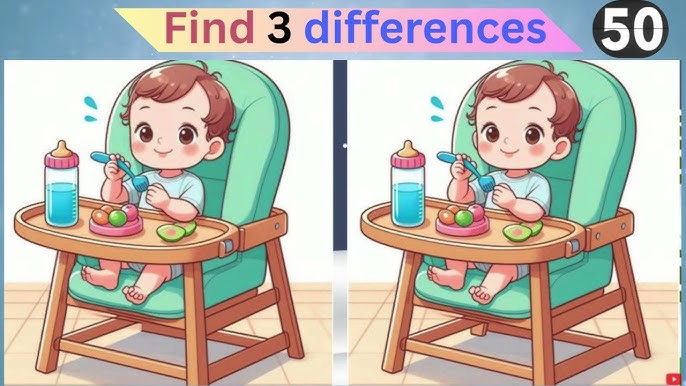
If you love visual puzzles that combine cuteness and challenge, this one’s for you! At first glance, the image of a happy baby sitting in a high chair seems simple and sweet. But look closer — things aren’t quite as identical as they appear.
This “Find 3 Differences” puzzle is not only delightful to look at, but it’s also a great way to sharpen your observation skills, boost focus, and give your brain a quick but meaningful exercise.
So grab your attention and let’s dive in — can you spot all three differences before we reveal them?
🍼 The Scene: A Baby’s Mealtime Moment
The illustration shows an adorable baby happily sitting in a green high chair, holding a spoon and enjoying a meal. On the tray in front of the baby, there’s a bottle, a plate with food (perhaps some colorful fruits or snacks), and a side dish. The background is clean and simple, making the baby and the mealtime setup the main focus.
Both images look nearly identical at first — the same charming expression, the same high chair, and the same warm tones. But the trick lies in the tiny differences. There are three small changes hidden between the two images, waiting for your eagle eyes to catch them.
🔍 The 3 Differences Revealed
Let’s take a closer look and uncover the subtle changes that make this visual puzzle so much fun.
1. The Baby’s Hair Curl Is Missing
Look closely at the baby’s hair on top of their head. In the image on the left, you can see a cute little curl near the front. But in the image on the right, that curl is missing!
It’s a small but noticeable difference once you know where to look. Hair details are often one of the easiest spots for puzzle designers to tweak, because our brains tend to gloss over them. Instead, we focus on faces, eyes, and smiles — so a missing curl often slips right past unnoticed!
This difference tests your facial detail recognition, one of the hardest areas for visual memory.
2. The Green Plate on the High Chair Is Missing a Piece of Food
Now take a look at the baby’s tray — specifically the green plate to the right. In the left image, you can see a small piece of food (maybe a pea or slice) resting on the plate. But in the right image, that little food item has vanished.
This kind of change targets your spatial awareness and peripheral attention. Because the item is small and not the main focus (unlike the baby’s face or bottle), your brain tends to overlook it. Yet once you notice it, it’s clear as day!
3. The Baby Bottle’s Cap Is Different
This one’s a classic visual trick — take a look at the baby bottle on the tray. In the left image, the bottle has a pink cap with a yellow nipple, while in the right image, the cap color slightly changes — it looks a bit lighter or lacks the detailed stripe near the top.

This subtle difference tests color perception and edge detection, both key visual processing skills. These small shifts in tone or line thickness are what make “spot the difference” puzzles deceptively challenging.
🧠 The Science Behind “Spot the Difference” Games
These charming puzzles aren’t just fun — they’re scientifically proven to improve cognitive and emotional well-being. Let’s break down how a simple visual game like this helps your brain in powerful ways.
1. They Strengthen Concentration and Focus
In our busy digital lives, staying focused on one thing for even a minute can be tough. “Spot the difference” puzzles require you to slow down and truly observe, training your brain to tune out distractions and focus on minute details.
Every time you identify a difference, your attention networks in the brain fire up — the same networks you use in problem-solving, studying, or working on complex tasks.
2. They Boost Visual and Working Memory
When comparing two similar images, your brain quickly stores small visual details from one picture and recalls them to match against the next. This strengthens your working memory — the type of memory responsible for short-term data processing.
Improved working memory can enhance your reading comprehension, note-taking, and even help you remember where you left your keys!

3. They Improve Eye-Brain Coordination
Your eyes are constantly scanning, identifying patterns, and sending signals to your brain to process what’s different. Over time, this improves visual perception speed, helping you spot inconsistencies in real-world situations more easily — from proofreading text to noticing small changes in your surroundings.
4. They Promote Mindfulness and Relaxation
Believe it or not, focusing deeply on visual puzzles can actually calm your mind. The repetitive process of scanning, comparing, and finding differences creates a meditative rhythm.
This state of focused attention — often called flow — reduces anxiety and stress, much like adult coloring books or jigsaw puzzles do. It’s mental relaxation through focus!
🎨 The Art and Design Behind the Puzzle
Let’s appreciate the artistic side of this adorable baby puzzle.
The artist uses soft pastel colors, smooth outlines, and symmetrical composition to make both images nearly identical. The baby’s round cheeks, gentle eyes, and subtle blush give the scene warmth and innocence.
By maintaining visual balance — the same lighting, chair position, and food placement — the creator makes the differences blend in naturally. Each small change (like removing a curl or altering the bottle cap) fits perfectly into the design, which is why they’re so hard to spot!

This clever artistry is what makes these puzzles so satisfying — they’re not random; they’re skillfully constructed to test your observation while pleasing your eyes.
💡 Tips to Find Differences Faster
Want to become a spot-the-difference master? Try these proven techniques:
- Scan systematically: Start from the top-left corner and move across row by row. Avoid jumping around randomly.
- Look at color zones: Areas with repetitive shades or patterns often hide subtle changes.
- Compare edges: Missing lines, shadows, or borders are common difference spots.
- Use peripheral vision: Sometimes, looking slightly away from the image helps you catch differences subconsciously.
- Take short breaks: If you’re stuck, look away for 10 seconds. When you return, the difference might pop out instantly.
🌈 Why These Puzzles Are Loved by All Ages
“Find the difference” games are timeless — they entertain and educate across generations.
- For kids: They develop early visual learning, hand-eye coordination, and patience.
- For adults: They provide a mental reset during busy days, improving focus and reducing stress.
- For seniors: They help keep cognitive functions sharp, stimulating memory and attention centers in the brain.
And since this particular puzzle features a cute baby, it adds an emotional touch — warmth, innocence, and joy — making the mental challenge feel comforting rather than stressful.
💬 The Psychology of Satisfaction
Every time you spot a difference, your brain releases dopamine, the feel-good neurotransmitter associated with accomplishment and reward. That’s why these puzzles feel so satisfying — they trigger mini “wins” that keep you motivated.
It’s the same neurological reward mechanism that drives us to complete levels in a game or finish a crossword. But unlike digital games, this one’s screen-light and stress-free!

👶 Lessons from the Baby Puzzle
Beyond being fun, this puzzle carries a gentle message — life’s most meaningful differences are often small and easy to overlook. Whether it’s a missing curl, a subtle color change, or a tiny detail on a plate, noticing those nuances teaches mindfulness and awareness.
In everyday life, these skills help us appreciate the world around us — from catching beauty in little things to recognizing when something’s slightly “off” and fixing it before it grows.
🧩 Final Thoughts
This “Find 3 Differences” baby puzzle might look simple, but it’s a delightful test of patience, observation, and focus. The missing hair curl, the vanished food piece, and the changed bottle cap together make a perfect trio of challenges — cute, clever, and cognitively enriching.
In just a few minutes, you’ve engaged your brain, improved your memory, and experienced a sense of calm focus — all while smiling at that adorable baby face.
So next time you come across a “spot the difference” puzzle, don’t scroll past — take a moment to play. Whether it’s to sharpen your mind or simply to unwind, these small visual challenges can make a big difference in your day. 🌟
Leave a Reply