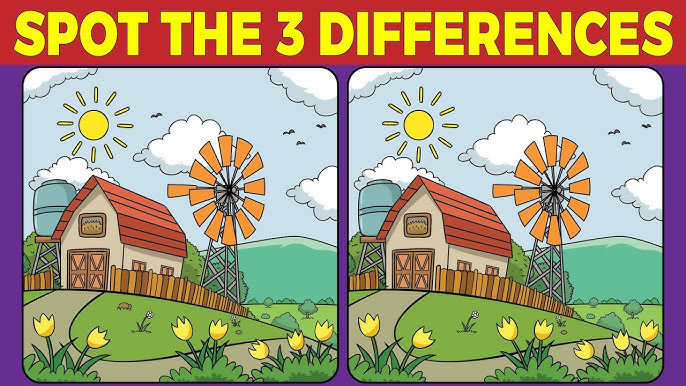
Visual puzzles have fascinated people of all ages for generations. From traditional “spot the difference” illustrations in newspapers to modern digital challenges on social media, these visual games continue to entertain, engage, and sharpen our observation skills. The image above — featuring a bright, colorful farm scene — invites viewers to do just that: spot the 3 differences between two seemingly identical pictures.
At first glance, both images appear to be the same — a cheerful countryside setting with a barn, windmill, flowers, and a sunny sky. But upon closer inspection, subtle variations hide in plain sight, waiting for a keen observer to notice them.
In this article, we’ll explore not just the differences in this picture but also the psychology, benefits, and history behind such visual puzzles. Get ready to test your attention to detail and learn why challenges like this are more than just fun — they’re exercises for your brain.
A Closer Look at the Puzzle
The image presents a picturesque farm scene. The left and right illustrations are nearly identical, with only three minor differences hidden within. To spot them, you need a blend of patience, focus, and visual memory.
Here’s what the scene includes:
- A barn with a red roof and wooden doors.
- A windmill turning beside the barn.
- A water tank standing tall in the background.
- A fence enclosing the area.
- Green hills, blue sky, and fluffy clouds.
- A bright sun shining above.
- A few birds flying and yellow flowers blooming in the foreground.
Now, let’s dive into the fun part — identifying the differences between the two versions.
The Three Hidden Differences
- The Sun’s Rays
- In the left image, the sun has twelve rays, radiating perfectly around it.
- In the right image, one of the rays is missing — making it slightly incomplete.
- This subtle change is easy to overlook since the overall brightness remains the same. However, observant viewers will quickly catch that something about the sun doesn’t look quite symmetrical.
- The Windmill Blades
- Take a close look at the windmill’s orange blades. On the left, there are eight blades, equally spaced.
- In the right image, one blade is missing, creating a visible gap.
- This difference adds an interesting challenge because the colors and shading are consistent, making it blend seamlessly unless you pay attention to the number of panels.
- The Missing Flower
- In the foreground, among the blooming yellow flowers, one flower on the right-hand side of the left image is missing in the right image.
- This difference adds variety to the challenge by shifting focus from the upper to the lower part of the picture.
- Because the vibrant flowers are numerous and evenly placed, it’s easy to miss the subtle absence of one bloom.
These three changes — small but deliberate — make this “spot the difference” puzzle both enjoyable and mentally stimulating.
The Psychology Behind Spot-the-Difference Puzzles
Spot-the-difference puzzles aren’t just for children’s activity books — they play a powerful role in developing cognitive and perceptual skills. Here’s how:

1. Enhancing Attention to Detail
When you compare two nearly identical images, your brain must slow down and examine each area carefully. This trains your selective attention — the ability to focus on small details while ignoring distractions.
2. Improving Visual Memory
As you scan the images, your brain holds one image in short-term memory while comparing it to the other. This strengthens visual memory retention, a skill crucial for daily life activities like reading, driving, or remembering faces.
3. Stimulating Pattern Recognition
Humans are natural pattern detectors. When you look at two images side by side, your mind automatically searches for inconsistencies. This activates the visual cortex, the brain region responsible for recognizing patterns, shapes, and spatial differences.
4. Reducing Stress
Engaging in simple puzzles like this can be relaxing. The quiet focus required helps reduce anxiety and induces a state of mindfulness — similar to meditation.

5. Boosting Cognitive Agility
The process of identifying differences keeps your brain active and flexible. Regular practice with visual puzzles is known to delay cognitive decline and enhance mental alertness, especially in older adults.
A Brief History of Spot-the-Difference Games
The origins of spot-the-difference puzzles can be traced back to the 19th century, when illustrated newspapers began including visual games for entertainment.
- In 1888, British illustrator William Ely Hill created one of the earliest popular visual illusions, paving the way for image-based puzzles.
- By the early 20th century, children’s magazines and Sunday newspapers began featuring “find the differences” as a recurring column.
- With the advent of digital media, these puzzles evolved into interactive online games and mobile apps, reaching millions worldwide.
Despite technological advances, the core appeal remains unchanged — the thrill of discovery, the satisfaction of finding hidden details, and the joy of visual play.
Why Spot-the-Difference Puzzles Are Still Popular
Even in today’s fast-paced, screen-saturated world, people love spot-the-difference puzzles. The reasons go beyond nostalgia:

- Instant Gratification – Each discovered difference provides a mini reward, triggering a dopamine release in the brain.
- Universal Accessibility – No language barrier, no complex rules — anyone can play.
- Short Engagement Time – It’s a perfect mental exercise that takes only a few minutes.
- Social Interaction – Friends and family can enjoy these challenges together, turning it into a fun group activity.
- Educational Benefits – Teachers use them to improve observation and focus in students, while therapists use them for cognitive exercises.
Tips for Solving Spot-the-Difference Puzzles
If you want to sharpen your skills and improve your accuracy, here are some helpful strategies:
- Scan systematically – Start from one corner and move across the image instead of jumping randomly.
- Divide the image – Mentally break it into smaller sections (top, middle, bottom).
- Look for symmetry – Most differences break the natural balance of objects.
- Pay attention to color and shape – Slight color changes or missing lines often indicate hidden differences.
- Zoom in (if digital) – On-screen puzzles can be easier to analyze when magnified.
The more you practice, the faster your brain will adapt to recognizing subtle differences instantly.
The Educational Value of Visual Puzzles
Beyond entertainment, visual puzzles like this farmyard scene hold tremendous educational value — especially for children:
- Cognitive Development – Encourages concentration and logical reasoning.
- Fine Motor Skills – When done on paper, circling differences enhances hand-eye coordination.
- Language Skills – Teachers can ask children to describe what they see, boosting vocabulary.
- Problem-Solving Ability – Children learn patience and analytical thinking by comparing images carefully.
Adults, too, benefit from these puzzles. Studies show that consistent engagement with visual problem-solving tasks can improve reaction time, memory, and mental flexibility.

Conclusion: A Simple Image, A Powerful Exercise
At first glance, the “Spot the 3 Differences” image looks like a simple children’s puzzle. But when we examine it closely, it becomes clear that it’s much more — it’s a brain workout, an art of observation, and a source of joy rolled into one.
By challenging your mind to focus, compare, and notice what’s hidden, you’re strengthening key mental faculties that help in everyday life. Whether you’re a child exploring new ways to learn or an adult looking for a short, engaging break from routine, puzzles like this offer both fun and function.
So next time you encounter a visual puzzle, don’t just glance at it — take your time, enjoy the hunt, and celebrate each difference you find. After all, in life as in puzzles, the smallest details often make the biggest difference.
Leave a Reply