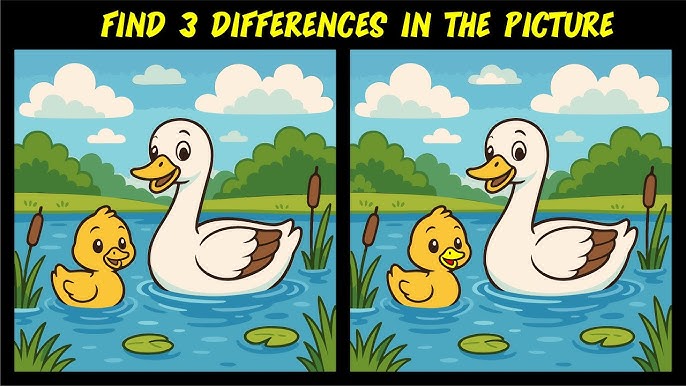
In a world dominated by fast-paced technology and constant distractions, it’s refreshing to slow down and engage in something that tests your patience, focus, and visual intelligence. One timeless activity that continues to delight both children and adults alike is the “spot the difference” puzzle. The image above — a charming illustration of a duck and its duckling enjoying a sunny day on a pond — is a perfect example of how a simple game can captivate our minds and bring out our inner detective.
At first glance, the two pictures look identical. Both show a serene pond, surrounded by reeds and lily pads, with a mother duck and her baby paddling together. However, hidden within these cheerful scenes are three small but clever differences waiting to be discovered. Let’s explore this puzzle in detail — and uncover not only the visual differences but also the fascinating science and benefits behind such observation games.
A Peaceful Scene with Hidden Twists
The illustration sets a peaceful, nature-filled atmosphere:
- A mother duck with white feathers and brown wings.
- A cute duckling swimming beside her.
- Calm blue water reflecting the sky.
- Lily pads, reeds, and green shrubs in the background.
- Puffy white clouds and a bright blue sky overhead.
Everything seems calm and ordinary. But as the image’s title suggests, there are three deliberate changes hidden between the left and right pictures. These differences are not immediately obvious — they require a sharp eye and careful attention to detail. Let’s find them one by one.
The Three Hidden Differences
1. The Missing Lily Pad
Look closely at the water in front of the duckling. In the left image, there are two lily pads floating on the surface. However, in the right image, one lily pad has mysteriously disappeared.

This subtle difference draws your eyes toward the calm water, making you notice the small variations in placement and design. Lily pads are recurring elements in pond scenes, and removing one makes the image appear slightly emptier — a clever trick that tests spatial awareness.
2. The Duckling’s Wing
Now, focus on the adorable baby duck. On the left side, the duckling’s wing is raised upward, giving it a cheerful, animated look. But in the right image, the wing is missing entirely — making the duckling appear smoother and simpler in outline.
This missing detail is easy to miss because the duckling’s shape and color remain mostly the same. Yet once you notice it, the difference becomes obvious. It’s a classic example of how our brains often overlook small features when we focus on the bigger picture.
3. The Cattail Plant on the Left
On the far left side of the image, near the edge of the pond, there’s a tall brown cattail plant rising from the water. In the left picture, the cattail stands proudly; in the right picture, it’s missing altogether.
This difference challenges your peripheral vision — it’s located far from the central subjects (the ducks), meaning you must scan the entire image rather than just the center. Such placement is intentional, encouraging a complete, systematic observation.

Why Spot-the-Difference Games Engage the Brain
While this might seem like a simple pastime, “find the difference” puzzles have surprising psychological and neurological benefits. They stimulate various parts of the brain, enhance focus, and even improve memory. Here’s how:
1. Training Visual Attention
Spotting differences between two images requires sustained attention and selective focus. You must examine shapes, colors, and patterns while ignoring irrelevant details. This strengthens the brain’s ability to filter out distractions — a skill valuable in everyday tasks like reading, driving, or studying.
2. Improving Memory and Concentration
When you compare images, your mind constantly switches between the two, temporarily storing small details. This strengthens working memory, the part of the brain that holds and manipulates information over short periods.
3. Enhancing Observation Skills
Observation is more than just looking — it’s about noticing. Puzzles like this one force you to slow down, look carefully, and recognize minute variations. These skills are crucial in professions that demand precision — such as design, medicine, architecture, and law enforcement.
4. Reducing Stress and Promoting Relaxation
Engaging in visual puzzles provides a form of mindful relaxation. The repetitive process of scanning, comparing, and finding differences calms the mind, similar to meditation or coloring. It encourages deep focus and helps relieve anxiety.

5. Boosting Brain Plasticity
Every time you solve a new visual challenge, your brain builds new neural connections. This improves neuroplasticity — your brain’s ability to adapt, learn, and form new habits even as you age.
The History of “Spot the Difference” Puzzles
The concept of “find the difference” puzzles dates back more than a century. The first widely recognized example appeared in the early 1880s, when illustrated newspapers began publishing them as entertainment for both adults and children.
- Early Origins: These puzzles often appeared in Sunday newspaper sections, accompanied by short stories or humorous captions.
- Mid-20th Century: They became a staple of children’s magazines, helping develop early learning and attention skills.
- Digital Age: Today, “spot the difference” games have evolved into mobile apps, video games, and educational tools that engage millions worldwide.
Despite changing formats, their essence remains the same — to engage our curiosity and challenge our perception.
Educational and Cognitive Benefits
Visual puzzles like this duck pond scene are not just fun — they’re deeply educational. Teachers, psychologists, and therapists often use them for developmental and cognitive exercises.
For Children
- Encourages focus and patience.
- Strengthens hand-eye coordination (when done on paper).
- Enhances vocabulary when describing differences.
- Promotes visual discrimination, an essential skill for reading and learning.
For Adults
- Improves attention span and mental agility.
- Helps with stress management by inducing calm focus.
- Keeps the brain active, potentially reducing risks of cognitive decline.
- Fosters teamwork and communication when solved collaboratively.
Such simple yet stimulating activities show that play can be a form of learning at any age.

Techniques to Solve “Spot the Difference” Puzzles Effectively
Want to get better at spotting differences quickly and accurately? Here are some expert tips:
- Start with a broad scan – Look at the overall layout, shapes, and colors before zooming in.
- Work systematically – Move from top to bottom or left to right to avoid missing areas.
- Compare specific elements – Focus on key features like faces, objects, and edges.
- Check symmetry – Many differences involve subtle asymmetry, such as missing items or shifted details.
- Take short breaks – Staring too long can cause visual fatigue. A quick break helps refresh perception.
- Practice regularly – Like any mental skill, observation sharpens with repetition.
The more you play, the quicker your brain becomes at recognizing patterns and noticing inconsistencies.
The Joy of Discovery
One of the most enjoyable aspects of spot-the-difference puzzles is the moment of discovery — that satisfying feeling when you finally notice what others might have missed. This sense of achievement releases small bursts of dopamine, the brain’s “feel-good” chemical, which keeps us motivated and eager to solve more.
In today’s overstimulated world, where instant gratification often rules, such small victories remind us of the joy of patience and persistence. They teach us that sometimes, slowing down and observing carefully leads to the most rewarding insights.
Conclusion: Simple Fun with Profound Benefits
The “Find 3 Differences” duck pond image is more than a cute picture — it’s a miniature brain exercise disguised as entertainment. By identifying the missing lily pad, the absent cattail, and the duckling’s vanished wing, you’re not only solving a puzzle but also giving your brain a meaningful workout.

Puzzles like these strengthen focus, enhance memory, improve observation skills, and promote mindfulness — all while providing lighthearted fun. They bridge generations, offering equal joy to children and adults, making them a timeless pastime that continues to thrive even in the digital era.
Leave a Reply