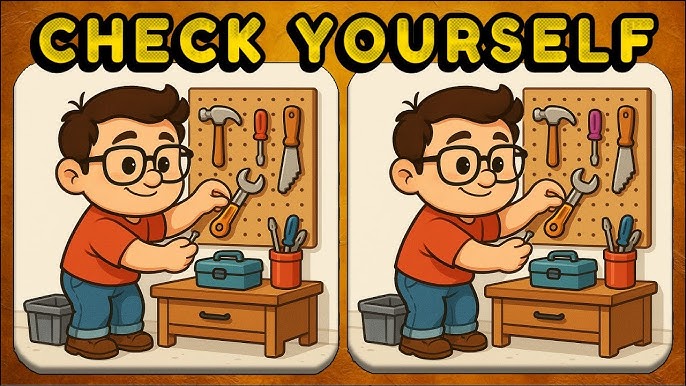
Spot-the-difference puzzles have been entertaining people for generations. Whether in newspapers, puzzle books, or now on social media, these little brain teasers challenge our ability to notice the smallest details hidden in plain sight. The picture puzzle above is one such challenge, featuring a cheerful boy in a workshop setting, surrounded by tools, a toolbox, and a workbench. At first glance, the two images look exactly the same—but don’t be fooled! There are three sneaky differences hiding between them.
The bold text at the top—“Check Yourself”—adds to the fun. It’s not just about finding the differences, but also about testing how sharp your eyes and brain really are. Let’s dive deeper into the puzzle, analyze its details, and reveal the hidden changes.
First Look at the Puzzle
The image shows a cute cartoon boy with glasses, dressed in jeans and a red shirt. He’s happily working in a workshop corner. Around him, you’ll notice:
- A pegboard with tools like a hammer, screwdriver, saw, and wrench.
- A blue toolbox on top of a wooden table.
- A red container holding pliers and other tools.
- A trash bin beside the table.
Both images look nearly identical, making it difficult to immediately notice what’s different. That’s the beauty of this puzzle—it trains your eyes to observe, compare, and question what you see.
The 3 Hidden Differences
After carefully inspecting both pictures, here are the three differences you’ll find:
1. The Boy’s Shirt Sleeve
- In the left image, the boy’s shirt sleeve is longer and covers part of his arm.
- In the right image, the sleeve is shorter, showing more of his arm.
This is a classic detail change. Many people overlook it at first because the mind is more focused on the tools and objects around the boy.
2. The Screwdriver on the Pegboard
- In the left image, the screwdriver hanging on the pegboard has a red handle.
- In the right image, the same screwdriver has a purple handle.
This difference is subtle but stands out once noticed. Color changes are among the trickiest because our brains often “assume” objects will remain consistent.
3. The Trash Bin Beside the Table
- In the left image, the trash bin is completely visible.
- In the right image, the bin is missing a part of its rim, looking slightly different.
This is the kind of sneaky alteration that can drive players crazy. Since the bin sits at the edge of the scene, our eyes don’t focus on it as much, making the difference harder to catch.

Why Are These Differences Hard to Spot?
Spot-the-difference puzzles may look simple, but they play clever tricks on the brain. Here’s why most people struggle:
- Visual Overload: The scene contains multiple objects. Our brains can’t focus on all of them at once, so some details slip through.
- Pattern Recognition Bias: The human mind processes big-picture patterns before focusing on minor details. We see “a boy in a workshop” instead of “the sleeve length is different.”
- Peripheral Blindness: Items near the edges (like the trash bin) are often ignored because we focus on the center.
- Color Perception: Small color changes (like the screwdriver handle) blend into the scene, and unless compared side by side, they’re easily missed.
This explains why some people only find one or two differences, while others give up before finding all three.
The Psychology of Spot-the-Difference Games
These puzzles aren’t just games—they engage deep cognitive processes. Psychologists often use similar exercises to study visual attention and working memory. Here’s what happens in your brain while solving:
- Attention to Detail: You train your brain to notice fine details rather than relying on assumptions.
- Memory Recall: You remember what you saw in one picture while comparing it to the other.
- Problem-Solving: You apply logic and systematic scanning to detect differences.
- Patience and Focus: These games require concentration, helping reduce stress and build mindfulness.
In fact, many educators and therapists use spot-the-difference puzzles with children to enhance observation skills, and with seniors to help maintain cognitive agility.

Benefits of Solving Such Puzzles
Apart from being fun, these puzzles offer several benefits for the brain:
- Improved Concentration: Staying focused on details helps strengthen attention span.
- Better Visual Processing: They sharpen the ability to analyze and compare images quickly.
- Enhanced Memory: You exercise short-term memory by remembering small details.
- Stress Relief: Puzzles are relaxing and can create a meditative state.
- Boost in Confidence: Finding the differences gives a sense of accomplishment.
In a world filled with distractions, such activities bring back the joy of simple, focused play.
Why “Check Yourself” Is a Perfect Title
The phrase “Check Yourself” in the puzzle isn’t random. It emphasizes that the challenge is not just about spotting differences—it’s about testing your own observation skills. It’s a playful reminder that:
- Sometimes we assume we’re observant, but we miss tiny details.
- Self-checking builds patience and sharpens awareness.
- Small wins in puzzles can boost confidence in real-life observation tasks too.
It’s a title that adds personality and motivation to the challenge.

Tips to Solve Spot-the-Difference Puzzles Faster
Want to improve your puzzle-solving speed? Here are some expert tips:
- Divide the Image: Mentally split the picture into sections and compare each part systematically.
- Look for Common Changes: Designers often alter clothing, colors, objects, and background details.
- Pay Attention to Edges: Small changes often hide at the borders where people rarely look.
- Take Your Time: Rushing makes you overlook details. Slow, careful scanning works best.
- Use Finger Pointing: Pointing at each object as you compare helps prevent skipping.
- Practice Regularly: Like any skill, observation improves with repetition.
By applying these techniques, you’ll soon spot differences much faster than before.
Why Spot-the-Difference Puzzles Never Get Old
Even in today’s digital age of video games and fast-paced entertainment, spot-the-difference puzzles remain evergreen. Why?
- They’re simple, requiring no complicated rules.
- They appeal to children, adults, and seniors alike.
- They can be enjoyed individually or shared with friends.
- They give a quick sense of achievement.
- They engage both the eyes and the brain, making them timeless fun.
They’re also highly social-media-friendly. People love sharing them with friends and competing to see who finds the answers first.

Final Thoughts
The workshop puzzle with the smiling boy and tools is more than just a cute cartoon—it’s a clever test of your observation skills. The three differences—the shirt sleeve length, screwdriver color, and trash bin detail—are easy to miss but satisfying to discover.
If you managed to find all three on your own, congratulations—you’ve got sharp eyes and focused attention! If you found one or two, don’t worry—every attempt sharpens your skills further. Remember, these puzzles are not just about winning, but about training your brain to slow down, observe carefully, and enjoy the process.
Leave a Reply