Brain teasers and puzzles are timeless activities that people of all ages enjoy. They test your observation skills, attention to detail, and patience while providing a fun mental challenge. Among the most popular puzzle types is the classic “spot the difference” game.
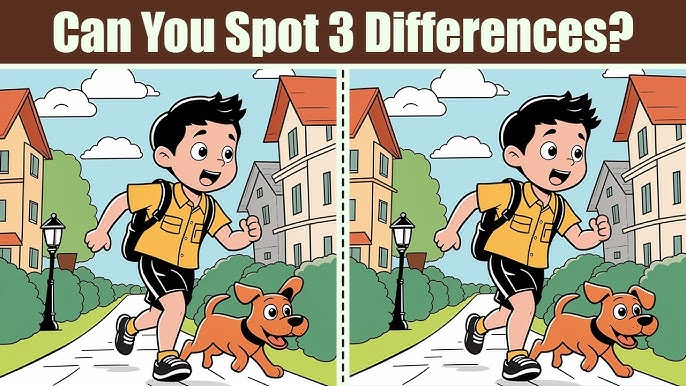
In today’s challenge, we bring you a vibrant illustration featuring a cheerful boy walking with his adorable dog in a lively neighborhood. The scene looks identical at first glance, but don’t be fooled—there are three subtle differences hidden between the two images. Your mission is simple yet tricky: find all three differences in just 10 seconds.
Ready to put your observation skills to the test? Let’s dive in!
The Puzzle Scene: A Stroll With a Loyal Dog
The image shows a young boy, dressed in a yellow shirt and black shorts, walking happily with his little dog along a clean pathway. The background captures a charming city neighborhood with:
- Buildings with red triangular rooftops.
- Bushes and trees adding greenery to the setting.
- Street lamps lining the path.
- A bright sky with fluffy white clouds.
At first glance, both images look exactly the same—but hidden within are three clever differences that only sharp eyes will detect.
The 3 Differences Hidden in the Puzzle
1. The Boy’s Shoe Detail
- In the left image, the boy’s left shoe has a white stripe.
- In the right image, the stripe is missing, leaving the shoe completely black.
This kind of clothing or accessory change is a classic trick used in spot-the-difference puzzles.
2. The Street Lamp Pole
- In the left image, the street lamp has a full stand with base.
- In the right image, the lamp post is missing its base, making it appear shorter.
Since the lamp is in the background, this detail is easy to overlook.
3. The Cloud in the Sky
- In the left image, there are two clouds above the rooftops.
- In the right image, only one cloud is present.
Background elements like clouds and trees often hide the trickiest differences because our brains naturally focus on the main characters—the boy and the dog.

Why This Puzzle Is Challenging
Spot-the-difference puzzles are not just about sharp eyes—they test how your brain processes visual information. When you look at two nearly identical images, your brain tends to focus on the overall picture rather than the fine details. That’s why small differences, like a missing shoe stripe or an extra cloud, can slip past unnoticed.
This challenge is especially fun because it combines both foreground differences (the shoe) and background differences (the lamp post and cloud), making it balanced and tricky at the same time.
The Psychology Behind Spot-the-Difference Games
These puzzles aren’t just entertainment—they tap into core cognitive processes:
- Pattern Recognition – Your brain is wired to recognize familiar shapes and compare them against one another. Differences break that pattern, forcing deeper concentration.
- Selective Attention – Most people focus on the boy and the dog, while subtle changes in the background are missed at first glance.
- Dopamine Boost – Every time you find a difference, your brain releases dopamine, which gives you a sense of accomplishment and motivates you to keep going.
That’s why solving puzzles like this is not only fun but also mentally rewarding.

Benefits of Playing Spot-the-Difference
Engaging in these visual challenges provides several benefits for both children and adults:
- Improves Attention to Detail: Helps sharpen the ability to notice small changes in the environment.
- Boosts Memory: Comparing visuals strengthens short-term and visual memory.
- Enhances Patience: These puzzles encourage focus and persistence.
- Reduces Stress: Concentrating on a fun activity helps the mind relax.
- Supports Learning in Kids: Children develop problem-solving, observation, and critical thinking skills while having fun.
It’s no wonder these puzzles are a favorite in classrooms, magazines, and online platforms worldwide.
Tips to Solve Spot-the-Difference Puzzles Faster
If you had trouble spotting the three differences, don’t worry—here are some proven strategies to improve your puzzle-solving speed:
- Scan systematically: Start from the top left corner and move across to the bottom right, instead of randomly looking at the whole picture.
- Focus on clothing and accessories: Pockets, shoes, hats, and small outfit details are often altered.
- Check the background last: Clouds, trees, and small objects in the background often contain subtle changes.
- Take short breaks: If you stare too hard, your brain gets tricked. Relax your eyes and look again—you’ll often notice differences instantly.
With practice, you’ll start spotting differences much more quickly.

Why Kids and Adults Both Love These Puzzles
Spot-the-difference puzzles have a universal charm because they’re simple yet engaging:
- For Kids: The colorful, playful illustrations make learning fun while developing observation and concentration skills.
- For Adults: They provide a nostalgic escape and act as mini mental workouts to sharpen the mind.
They’re also great family activities—parents and kids can solve them together, making them both fun and educational.
Real-Life Relevance of Spot-the-Difference Skills
Believe it or not, the skills developed through these puzzles have practical real-world applications:
- Professionals like editors, designers, and engineers often rely on sharp observation to spot errors or inconsistencies.
- Drivers and pilots benefit from enhanced attention to detail, which improves safety.
- Students can improve focus while studying, as the brain becomes more attuned to noticing details.
In short, these puzzles aren’t just games—they’re tools to strengthen useful cognitive skills.

Final Thoughts
The boy-and-dog puzzle is more than just a charming illustration—it’s a clever test of observation. The three differences are:
- The missing stripe on the boy’s shoe.
- The altered street lamp base.
- The missing cloud in the sky.
If you spotted all three within 10 seconds, congratulations! You’ve got sharp eyes and excellent focus. If not, don’t be discouraged—these puzzles are designed to challenge your brain and keep you engaged.
Remember, every time you practice, you’re training your brain to be sharper, quicker, and more attentive. So the next time you see a spot-the-difference puzzle, dive in—you’ll be giving yourself a fun mental workout while enjoying the thrill of discovery.
Leave a Reply