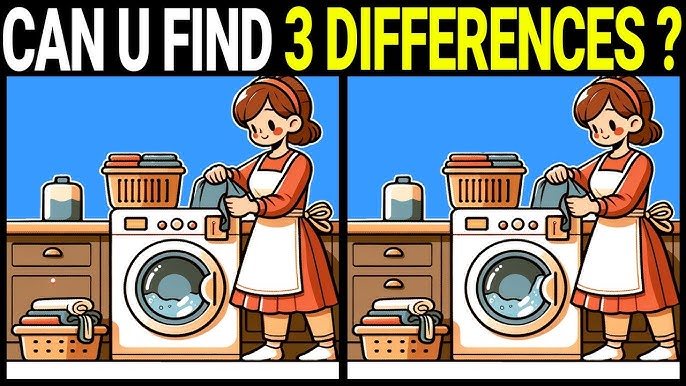
Spot-the-difference puzzles have long been a favorite pastime for people of all ages. Whether you’re a child exploring puzzles for fun or an adult looking for a quick brain workout, these games never fail to entertain while sharpening your observation skills. Today’s challenge comes with a domestic twist—a woman doing laundry—and your task is to find the three differences between the two images.
At first glance, both pictures seem identical. The washing machine, the folded laundry, the woman in an apron—all look the same. But look closer, and you’ll notice subtle details that have been cleverly altered. Ready to test your eyes and brain? Let’s dive in!
The Scene: A Household Laundry Moment
The illustration shows a cheerful woman engaged in a household chore—doing laundry. Here’s what stands out in the picture:
- A washing machine at the center, with clothes spinning inside.
- A laundry basket stacked with neatly folded clothes sits nearby.
- Another basket with towels rests at the bottom left corner.
- The woman, dressed in a red dress with a white apron, is carefully placing clothes into the machine.
- A background counter with drawers and bottles completes the homey setting.
It’s a simple yet charming domestic scene, designed to hide small but noticeable differences.
The Challenge: Find 3 Differences
Now comes the fun part—spotting the differences! If you haven’t attempted the puzzle yet, pause here and carefully scan both images from top to bottom.
Ready for the reveal? Let’s go through the three differences one by one.
1. The Bottle Cap on the Counter
- In the left image, the bottle cap on the counter (to the left of the woman) is dark gray.
- In the right image, that same cap is white.
This difference is small but noticeable once you focus on the background objects.
2. The Laundry Basket at the Bottom Left
- In the left image, the folded towel on the laundry basket has stripes.
- In the right image, the towel is plain with no stripes.
This one plays on our tendency to overlook minor texture or pattern changes.

3. The Washing Machine Door Reflection
- In the left image, the washing machine door reflection shows a bubble-like detail inside.
- In the right image, that detail is missing or altered.
This is perhaps the trickiest difference, since our eyes tend to gloss over reflective surfaces.
So, the three differences are:
- The bottle cap color.
- The towel pattern on the laundry basket.
- The washing machine door reflection.
Why This Puzzle Is Engaging
What makes this particular puzzle so clever is the distribution of differences:
- Background item (the bottle cap).
- Foreground accessory (the towel).
- Main focal object (the washing machine).
By placing differences in different zones, the puzzle forces you to look carefully at all parts of the picture rather than focusing only on the characters. This keeps your brain active and engaged.

The Science Behind Spot-the-Difference Games
These puzzles may look simple, but they actually stimulate the brain in powerful ways:
- Attention to Detail – They train your eyes to notice even the smallest changes.
- Visual Memory – You need to remember what you’ve just seen in one image while comparing it to the other.
- Focus and Patience – Spotting subtle differences takes concentration, improving your mental stamina.
- Cognitive Flexibility – Your brain switches between the two images, strengthening mental agility.
This is why spot-the-difference puzzles are not just games—they’re brain exercises.
Real-Life Benefits of Playing These Puzzles
Believe it or not, practicing observation through puzzles like this can have practical benefits in daily life:
- Students develop sharper focus for studying and problem-solving.
- Professionals like designers, editors, and quality controllers improve their ability to catch mistakes.
- Healthcare workers can enhance their ability to notice small changes in patient conditions.
- Everyday life becomes smoother—you’ll notice misplaced objects, driving cues, and household details more easily.
Tips to Solve Spot-the-Difference Puzzles Faster
If you found this puzzle tricky, here are some strategies to boost your skills:

- Divide the image into sections: Compare top, middle, and bottom separately.
- Check repetitive elements: Patterns, textures, and shapes often hide changes.
- Focus on accessories and backgrounds: These are common areas where artists insert differences.
- Take your time: Rushing causes you to miss small details.
- Practice daily: The more puzzles you solve, the sharper your eyes become.
Why Laundry Is a Fun Theme for This Puzzle
Laundry is an everyday activity most of us can relate to, making this puzzle feel familiar and cozy. By taking a routine chore and turning it into a brain game, the puzzle becomes both relatable and entertaining.
The use of simple household objects like baskets, bottles, and towels makes the differences subtle yet rewarding when spotted. Unlike puzzles with fantastical themes, this one feels grounded in reality, which makes the challenge even more enjoyable.
The Fun of Family Puzzles
This laundry-themed puzzle isn’t just for individuals—it’s great for families too. Parents can challenge their kids to spot differences, turning it into a fun bonding activity. It’s educational for children, helping them develop visual perception skills, while also relaxing for adults who want a quick break from their busy schedules.
Final Thoughts
This laundry-themed “Spot the 3 Differences” puzzle is a perfect blend of fun and brain training. It challenges your eyes, sharpens your focus, and rewards you with the satisfaction of discovery.

Leave a Reply