Visual brain teasers have always held a special charm. Whether you’re flipping through a magazine, scrolling on social media, or engaging with an educational workbook, spot-the-difference puzzles are one of the most beloved challenges. They’re fun, deceptively tricky, and surprisingly beneficial for your brain.
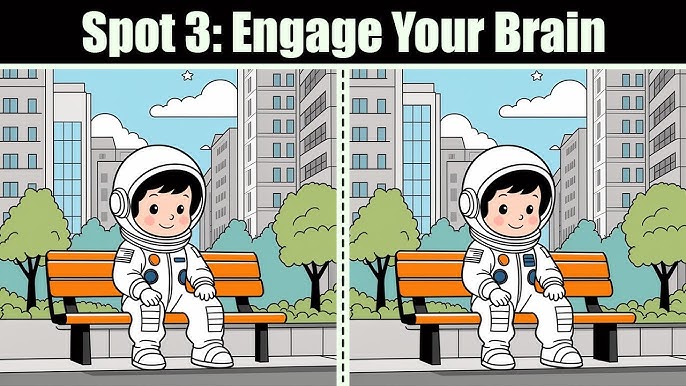
Today’s challenge features a delightful illustration of a child astronaut sitting on a park bench, surrounded by trees, skyscrapers, and clouds. At first glance, both images look identical—but don’t be fooled. Hidden within the scene are three subtle differences waiting for your sharp eyes to detect.
The puzzle is titled: “Spot 3: Engage Your Brain.” And it’s more than just a playful activity—it’s an invitation to give your brain a workout while having fun. Let’s dive into this engaging challenge.
A First Look at the Astronaut Puzzle
In both images, we see:
- A cheerful child dressed in a white astronaut suit with patches and buttons.
- An orange park bench providing a striking contrast to the green trees and gray skyscrapers.
- A cityscape backdrop with tall buildings, fluffy clouds, and a peaceful vibe.
At first glance, the two images look like mirror copies. But careful observation reveals three changes that transform the picture in subtle ways.
The Three Differences Revealed
1. The Astronaut’s Arm Patch
In the left image, the astronaut has a patch with a circle on the upper arm of the suit. In the right image, that patch is missing.
Why it’s tricky: Patches are small details, and since the suit is already decorated with various buttons and lines, it’s easy for the brain to gloss over one missing symbol.
2. The Park Bench Slats
Look carefully at the orange bench where the astronaut is sitting. In the left image, the bench has four horizontal slats. In the right image, one of the slats is missing, making the seat appear slightly different.
Why it’s tricky: The brain tends to see the bench as a single shape, not separate parts. Unless you count the slats individually, this difference blends into the background.
3. The Cloud in the Sky
In the background sky, near the top right corner, a fluffy cloud appears in the left image. In the right image, the cloud is missing entirely, leaving more blue sky visible.
Why it’s tricky: Background elements like clouds, stars, and trees are often overlooked because the main subject (the astronaut) captures our attention first.
Why This Puzzle Captures Attention
What makes this puzzle fascinating is the blend of a whimsical theme and a real mental challenge. The astronaut isn’t just sitting in space—it’s a playful contradiction of contexts: a space explorer relaxing on a simple park bench in a modern city. This quirky setup keeps the puzzle lighthearted, while the differences themselves push your brain to work harder.
The challenge is designed around cognitive blind spots—places where our perception often fails. Small details like patches, repetitive objects like bench slats, and background elements like clouds are classic spots for hiding differences because our brains are wired to filter them out.
The Science Behind Spot-the-Difference Puzzles
Spotting differences between two similar images might feel like child’s play, but it actually taps into deep cognitive processes. Here’s why it’s such a brain booster:
1. Visual Processing
Your brain’s visual cortex works overtime to scan shapes, patterns, and colors. This puzzle forces your mind to differentiate between nearly identical visuals, strengthening your ability to detect anomalies.

2. Attention to Detail
Our brains like efficiency, often generalizing images as “the same.” Spot-the-difference puzzles disrupt that tendency, making you slow down and look carefully.
3. Memory Engagement
Comparing one image to another requires holding details in working memory, testing your recall abilities in real time.
4. Problem-Solving Skills
Puzzles train your brain to strategize: Should you scan top to bottom, left to right, or focus on specific features first? This strategic approach strengthens problem-solving pathways.
Why Puzzles Like This Are Good for the Brain
Beyond just fun, these puzzles provide real mental benefits:
- Improves Focus: Trains you to stay engaged and avoid distractions.
- Strengthens Patience: Encourages slowing down, persistence, and careful observation.
- Enhances Visual Memory: Helps you remember patterns, shapes, and small details.
- Reduces Stress: Offers a mindful, meditative escape that’s both entertaining and relaxing.
- Boosts Creativity: Seeing subtle changes improves flexible thinking and creative problem-solving.
Tips for Spotting Differences Like a Pro
Want to get faster at solving puzzles like this? Here are some tried-and-true strategies:

- Scan Methodically
Instead of jumping around randomly, start from one corner and move systematically across the image. - Look at Backgrounds First
Many differences hide in clouds, trees, or buildings. Since most people focus on the main subject, check the background for surprises. - Check Repetitive Objects
Items like benches, windows, or buttons often have missing parts that are easy to miss. - Blink Between Images
Move your eyes back and forth quickly. Subtle differences often “pop out” with this technique. - Zoom In
If you’re doing the puzzle digitally, zooming can help you notice smaller changes.
Why Astronauts Make the Puzzle Even More Fun
The choice of an astronaut as the subject isn’t just random—it taps into a universal fascination with space exploration. Astronauts symbolize curiosity, bravery, and discovery, making the puzzle feel adventurous. At the same time, placing the astronaut in a park, doing something as ordinary as sitting on a bench, adds humor and charm.
This playful contrast keeps your brain engaged by mixing the extraordinary (space travel) with the ordinary (a city park bench).
Who Should Try Spot-the-Difference Puzzles?
These puzzles are for everyone!
- Children: Great for developing attention, memory, and patience.
- Adults: Perfect for stress relief, relaxation, and keeping the mind sharp.
- Seniors: Help improve cognitive agility and delay age-related decline in focus and memory.
They’re also excellent tools for teachers, therapists, and team-building exercises.
Did You Find All Three Differences?
If you spotted all three differences quickly—the missing patch, the missing bench slat, and the missing cloud—congratulations! You have excellent observation skills.

If you found only one or two, don’t worry. The more you practice, the better you’ll get. Spot-the-difference puzzles are like exercise for the brain: the more you train, the sharper you become.
Final Thoughts
The “Spot 3: Engage Your Brain” astronaut puzzle isn’t just a casual time-killer—it’s a meaningful mental workout hidden in a fun, colorful scene. It challenges you to slow down, pay attention, and think critically while enjoying the playful charm of a child astronaut in a park.
So next time you come across a puzzle like this, don’t just glance at it—dive in. Test your skills, engage your brain, and enjoy the satisfying “aha!” moment when you finally uncover all the hidden differences.
After all, brain fitness doesn’t have to be boring. Sometimes, it looks as fun as an astronaut on a park bench.
Leave a Reply