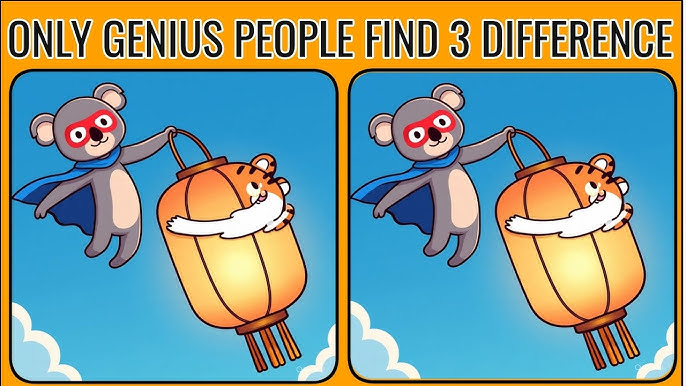
In an age filled with digital noise and attention-hogging apps, sometimes the simplest challenges prove to be the most entertaining—and surprisingly, the most intellectually stimulating. Enter the good old “Spot the Difference” puzzle. Today’s brain teaser features an adorable flying bear and a happy orange lantern soaring through the sky with a cute kitty clinging on for dear life.
But don’t let the playful cartoon fool you. Hidden in this cheerful scene are three tricky differences that only the sharpest minds will catch. If you’re someone who loves puzzles, pattern recognition, or visual challenges, this one’s for you.
Let’s dive into the details of this puzzle, discover the differences, and explore why these visual games are more than just time-killers—they’re mind-boosting power tools.
🎨 The Scene: A Bear, a Balloon, and a Brave Cat
Before spotting the differences, take a moment to appreciate the charming illustration.
- A bear in a blue superhero cape is flying through the sky, holding a string attached to a glowing orange lantern.
- Clinging to the side of the lantern is a small white cat with orange ears, clearly enjoying the ride.
- The bright blue sky, fluffy clouds, and radiant colors create a joyful, uplifting mood.
But lurking within this picture-perfect moment are three subtle inconsistencies between the two images. Have you spotted them yet?
🔍 The 3 Differences: Spotted and Explained
Let’s examine the image more closely and highlight the three visual differences between the left and right panels.
1. 🐱 The Cat’s Ear Has Vanished
Left Image: The cat hanging onto the lantern has two ears—one orange and one white—clearly visible as it clutches the lantern.
Right Image: The left ear (from the viewer’s perspective) is completely missing. It looks like the ear has been magically erased, making the cat look a bit unusual.
Why It’s Clever: Our brains are trained to recognize faces and familiar creatures like cats quickly. So when an element is subtly removed—like an ear—it’s easy to overlook, especially when the rest of the cat is intact.
2. 🎈 Missing String Segment
Left Image: The string connecting the superhero bear’s hand to the lantern is fully intact, creating a complete connection from paw to light.
Right Image: A segment of the string is missing, just below the bear’s hand. The rope seems to hover in midair.
Why It’s Clever: This one challenges your sense of continuity. Our brains naturally “fill in” incomplete lines, so the missing string doesn’t immediately register unless you’re specifically comparing the two images side-by-side.

3. ☁️ Cloud Shape Has Changed
Left Image: In the lower-right corner of the image, the cloud shape is rounded and smooth, with fewer defined peaks.
Right Image: The cloud has an extra “bump” or peak, making it visibly different in shape.
Why It’s Clever: Background differences like this are classic puzzle tricks. Your focus is naturally drawn to the main characters (the bear, cat, and lantern), so it’s easy to miss subtle differences in the sky or background unless you’re scanning purposefully.
🧠 The Science of Spot-the-Difference Games
Spot-the-difference puzzles may look like child’s play, but they actually activate several key areas of the brain. Cognitive scientists have found that these puzzles:
1. Enhance Visual Memory
You’re comparing two images and remembering small details from each, reinforcing short-term and long-term memory use.
2. Improve Attention Span
To find subtle differences, you need focus. Solving these puzzles boosts your brain’s ability to sustain attention over time.

3. Train Pattern Recognition
You’re hunting for what’s out of place—be it missing parts, shifted colors, or altered shapes. This strengthens your brain’s ability to detect patterns and anomalies.
4. Sharpen Observational Skills
In real life, the ability to notice what’s out of place (like missing keys or an incorrect calculation) is a crucial life skill. These games help refine that skill in a fun way.
🧒👵 Fun for All Ages
One of the great things about spot-the-difference puzzles is their universal appeal. Whether you’re a preschooler learning shapes or a senior keeping your brain sharp, these puzzles offer age-appropriate benefits.
For Kids:
- Develops visual tracking and attention to detail
- Teaches object recognition and spatial awareness
- Builds patience and concentration
- Can be gamified for use in classrooms or homeschool environments
For Adults:
- Acts as a mental warm-up for work or creative tasks
- Helps reduce digital fatigue with quick visual stimulation
- Offers a form of stress relief and light mental exercise
- Keeps the mind engaged during breaks or downtime
🕵️ Pro Tips: How to Get Better at Spot-the-Difference Games
Not everyone gets all the differences right away—and that’s OK! Here are some expert-level strategies to improve:
1. Look in Layers
Start with the background (clouds, sky), then move to midground (objects), then foreground (characters).
2. Zoom in and Scan
If viewing digitally, zoom in and slowly scan each image from top to bottom.

3. Use Peripheral Vision
Sometimes looking indirectly helps spot anomalies more easily than direct focus.
4. Take Breaks
If you’re stuck, step away for a moment. Returning with fresh eyes helps spot previously missed differences.
🧠 Boosting Brain Health with Play
According to research from the National Institute on Aging and other cognitive health institutions, activities that stimulate the brain through visual and mental challenges can help delay age-related cognitive decline. Spot-the-difference puzzles provide just that kind of stimulation.
They:
- Encourage problem-solving
- Promote mindful observation
- Help develop a growth mindset (“I can figure this out!”)
What’s more, they offer an enjoyable, non-stressful way to engage with media—an increasingly rare thing in our overstimulated world.
🌈 The Design: Colorful, Wholesome, and Clever
This particular image uses a colorful cartoon art style that appeals across age groups. Let’s take a quick look at what makes the design so effective:

- Bright, Happy Colors: Orange, blue, and white make the image cheerful and optimistic.
- Cute Characters: The bear in a cape and cat on a lantern create a fun, imaginative vibe.
- Simple Sky Background: The clean background allows differences to stand out subtly, without overwhelming the viewer.
- Visual Harmony: Despite the differences, both images feel complete—which makes spotting the oddities more satisfying.
📋 Summary Table: All 3 Differences
| No. | Difference | Location in Image |
|---|---|---|
| 1 | Cat’s ear missing | Cat on the lantern |
| 2 | Rope segment missing | Bear’s hand to lantern |
| 3 | Cloud shape different | Bottom-right corner |
🎯 Final Thoughts: Are You in the Genius Club?
If you managed to find all three differences without peeking, you’re part of the rare few who can spot minute visual changes with ease. That’s no small feat—this requires a blend of memory, pattern recognition, and laser-sharp focus.
And if you didn’t find them all right away? That’s okay too. Puzzles like this are meant to challenge your brain and train it to notice things you usually wouldn’t.
So keep going, keep playing, and keep noticing. You never know what details you might be missing—not just in puzzles, but in life itself.
Leave a Reply