In a world filled with fast-paced entertainment, sometimes it’s the simple pleasures—like a good visual puzzle—that bring the most satisfaction. Whether you’re a child learning to observe your surroundings or an adult seeking a quiet moment of mental stimulation, “Spot the Difference” puzzles offer timeless charm and brain-boosting benefits.
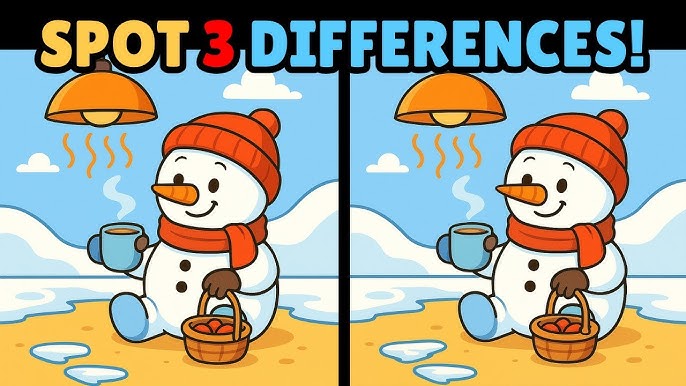
Today’s challenge brings a fun and ironic twist: a snowman sitting on the beach, sipping a hot drink, and enjoying the sun—yes, you read that right! Our frosty friend is soaking up the warmth in an unusual setting, and there are three subtle differences hidden between the two images. Can you spot them all?
☀️ Scene Overview: A Snowman’s Day at the Beach
The playful image captures a surreal yet delightful moment: a snowman, complete with a carrot nose, winter hat, red scarf, and coal buttons, is lounging on a sunny beach.
In both images, we see:
- A snowman sitting on the sand, holding a blue mug.
- A cozy orange beanie and scarf keeping him stylish.
- A basket filled with red apples.
- A large overhead heat lamp radiating warmth.
- A wintry ocean backdrop with gentle waves, clouds, and blue skies.
The two images are almost identical—but with careful inspection, you’ll spot three key differences. Let’s dive in and explore not only what they are, but what makes puzzles like this so beneficial.
👁️🗨️ Can You Spot the 3 Differences?
Put on your detective hat (and maybe a scarf to match the snowman’s), and look closely. Here are the three differences you’ll find:
✅ 1. Missing Cloud (Top Right)
In the left image, there is a small white cloud floating near the top right corner of the sky. In the right image, that cloud is missing.
👉 What it tests: Your peripheral vision and attention to background details. Our eyes naturally focus on central characters (like the snowman), so spotting differences in the sky requires a trained observational eye.
✅ 2. Snowman’s Button Missing
Look closely at the snowman’s body. In the left image, there are three black coal buttons. In the right image, the middle button is missing, leaving just two.
👉 What it tests: Your pattern recognition. Our brains tend to assume symmetry and consistency in characters. Spotting a missing element in a repetitive design sharpens visual memory.
✅ 3. Heat Lamp Wire Missing
Above the snowman, a heat lamp radiates warmth. In the left image, you can clearly see the wires or heating coils (orange lines) coming from the lamp. In the right image, the middle coil is missing, making it look less intense.
👉 What it tests: Your ability to spot changes in subtle shapes and repeated visual patterns.
🧠 Why Do “Spot the Difference” Puzzles Work So Well?
These kinds of puzzles may seem lighthearted, but they’re powerful tools for mental stimulation. Let’s explore the psychological and neurological benefits of playing these visual games.
🧩 1. Trains Visual Attention
Spot the Difference puzzles require you to visually scan images, focus on details, and remember what you’ve seen—all while filtering out irrelevant information. This process improves selective attention, a critical skill in everyday life.
🧠 2. Enhances Short-Term Memory
You often have to mentally compare one side of the image to the other. This strengthens working memory—the ability to hold and manipulate information in your mind. Strong short-term memory aids in reading comprehension, math skills, and decision-making.
👁️ 3. Sharpens Observation Skills
The more you practice, the better you get at spotting the smallest inconsistencies. This skill translates to professions that rely on accuracy—such as design, quality assurance, coding, forensics, and even medicine.
🎯 4. Boosts Cognitive Flexibility
Switching your focus between elements of the image requires mental flexibility. This can improve your ability to solve problems creatively, adapt to change, and think outside the box.
🧘♀️ 5. Promotes Mindfulness and Focus
Focusing on a fun yet challenging task helps you tune out distractions. It’s a calming experience that increases mindfulness, reducing anxiety and promoting a sense of achievement.

🎓 Educational Value for All Ages
“Spot the Difference” puzzles aren’t just for kids—they’re valuable across all age groups:
🧒 For Children:
- Teaches object recognition and spatial awareness.
- Develops vocabulary (e.g., “basket,” “scarf,” “lamp”).
- Encourages counting and sequencing (how many buttons, clouds, etc.).
🧑🎓 For Teens and Adults:
- A great way to train focus and improve accuracy, especially in academic or high-pressure work environments.
- Helps reduce screen fatigue by engaging with visual content passively.
👵 For Seniors:
- Supports cognitive health, delaying memory decline.
- Encourages visual scanning, memory recall, and attention.
🌍 A Snowman at the Beach? Let’s Talk Themes!
The snowman sitting under a heat lamp by the ocean might seem absurd—but it’s a clever artistic contradiction. This juxtaposition adds humor and makes the puzzle more engaging.
❄️ Symbolism & Humor:
- Snowman in a hot place: This represents contradiction and irony, keeping the viewer entertained.
- Warming up with hot cocoa: Adds coziness, evoking a sense of calm and comfort.
Using whimsical or unexpected scenes increases the emotional connection with the puzzle and makes it more memorable.
🔥 How to Solve These Puzzles Efficiently
Want to improve your puzzle-solving speed and accuracy? Here are some pro tips:
🧭 1. Start with the Background
We naturally look at characters first. But differences are often hidden in the sky, background, or edges. Start there.
🔄 2. Compare Systematically
Don’t scan randomly. Divide the image into sections—top left, bottom left, center, etc.—and compare piece by piece.

👀 3. Look for Odd Numbers
Count objects—clouds, buttons, fingers, waves. If one image has more or fewer, you’re onto a difference.
🔍 4. Use Color and Shape Detection
Differences often involve color swaps, object removal, or rotation. Train your brain to spot these quickly.
🎨 Why Cartoony Illustrations Work Best
The use of bold outlines, simple colors, and exaggerated features in cartoon puzzles makes spotting differences fun yet challenging.
Benefits include:
- Clarity: Clear shapes are easier to compare.
- Visual impact: Brighter colors increase engagement.
- Artistic freedom: Subtle changes are easier to hide or reveal with stylized illustrations.
📱 Digital vs. Print: Which is Better?
These puzzles are great in both formats:
- Digital: Allows zooming, side-by-side switching, and interaction.
- Print: Engages tactile senses; ideal for kids and seniors to solve offline.
Apps, websites, and activity books all offer different experiences depending on age, ability, and context.

✍️ Puzzle-Making Tips for Educators or Creators
Thinking of making your own Spot the Difference puzzles? Keep in mind:
- Use 3–5 differences for beginner levels, and up to 10+ for advanced puzzles.
- Alter background elements, facial features, and object positioning for subtlety.
- Maintain consistent color themes to avoid confusion.
- Add themes (e.g., beach, winter, animals) to keep it fun.
🔚 Conclusion: A Puzzle That Melts Stress, Not Snowmen
This snowman may be chilling in an unusual place, but the puzzle he stars in is a perfect warm-up for your brain. Simple, creative, and cleverly designed, “Spot the 3 Differences” images like this one remind us that fun and learning can go hand in hand.
Whether you’re solving alone over coffee, with kids in the classroom, or with seniors at home, this lighthearted brain game does more than pass time—it builds skills that last a lifetime.
So next time you see a snowman sipping cocoa under a heat lamp on the beach, look twice—you might just spot something you missed the first time!
❓Did you find all three differences on your own?
Let us know which one stumped you the most. Want more puzzles like this? Reach out and we’ll create a custom set just for you!
Leave a Reply